

Who takes the lead when no one is in charge?
interview
Police, municipalities and public organisations increasingly work together in networks to solve social problems. Cooperation is necessary but complex. Without clear leaders, different forms of leadership are needed. PhD candidate Moniek Akerboom studied how leadership develops in public networks.
Your PhD research focuses on leadership in public sector networks. Why did you choose this topic?
‘As citizens, we place high expectations on the government. When it comes to contemporary societal challenges, we often look to public authorities for solutions, such as the illegal dumping of drug waste in nature or individuals displaying confused behaviour in public spaces. These issues are too complex for a single organisation to address. They require the involvement of the police, mental health services, public health authorities and inspection bodies. Together, these actors form networks to exchange knowledge and expertise, but this also creates significant leadership challenges.’
Why is that a challenge?
‘Public organisations are traditionally quite hierarchical, with managers directing their own staff. In partnership networks, organisations work on an equal basis so there are no clear ‘leaders’. My research shows that each network is different. Sometimes one or a few people take the lead; sometimes leadership is shared. When professionals pursue only their own goals or make decisions without consultation, this harms the network. If the focus shifts to the largest partner’s goals then trust is reduced.
Through interviews, I examined how professionals view leadership dynamics. Participants evaluated one another in several networks.’
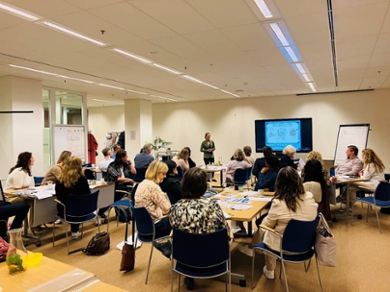
When it is unclear who is in charge, does this make it easier to avoid responsibility?
‘Some individuals tend to adopt a more passive attitude based on assumptions about who should lead. Organisations such as the police and the Public Prosecution Service have traditionally placed strong emphasis on authority and leadership, whereas social organisations often rely on volunteers. As a result, stereotypes may prevail, leading people to look to the police and prosecutors as the natural authority figures. This is rarely stated explicitly, but it clearly emerged in the individual interviews I conducted.’
What struck you most during these conversations?
‘That leadership can take many different forms. Task-oriented behaviour, such as setting and evaluating goals, is widely regarded as important. Relationship-oriented leadership, including showing interest, offering compliments and celebrating successes, is also valued. In addition, change-oriented leadership – having a clear vision of the societal problem and how best to address it – plays a role. Finally, professionals in networks often display externally oriented leadership, acting as ambassadors to raise awareness and secure funding for their work.
However, leadership is shaped by the organisational context in which members operate. If a person’s manager does not support their involvement, it becomes more difficult to commit to the network. The organisations behind the participants therefore influence how individuals function within the collaboration. It is a continuous balancing act between serving one’s own organisation and contributing to the shared societal objective of the network.’
What advice can you offer for effective collaboration within networks?
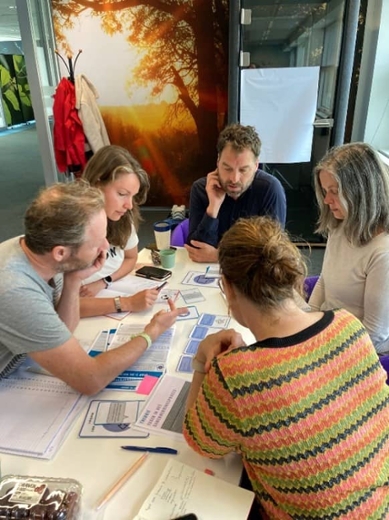
‘I developed a serious game to facilitate structured dialogue on these issues. Using statement cards, participants discuss what is working well and what could be improved. This helps identify bottlenecks and clarifies the type of leadership required to move the network forward. Participants reflect on their goals and how they wish to exercise leadership.’
Have you observed how the game works in practice?
‘Yes, I developed the game in collaboration with organisations involved in networks, such as the Social Insurance Bank, the Municipality of Leiden and the Custodial Institutions Agency. Together, we tested and refined the questions, always keeping in mind what the game should teach the participants.
During gameplay, meaningful discussions about leadership emerged. Three months later, I followed up to assess any lasting effects. Participants reported increased awareness of leadership dynamics, clearer communication of needs and the identification of issues that would otherwise have remained hidden. I recommend that networks use the game annually as a moment for reflection and evaluation. Coaching can then serve as a valuable addition to work with the outcomes and strengthen leadership dynamics within the network.’
Serious game – Leadership without Borders (in Dutch)
Leadership without borders is a serious game designed to support professionals in enhancing collaboration and leadership within inter-organisational chains and networks. The game enables participants to engage in joint reflection on their cooperation, gain insight into strengths and areas for improvement, and determine the type of leadership required to realise shared objectives more effectively.
The game was developed as part of the 'Verder met Publiek Leiderschap' programme by Dr. Moniek Akerboom of the Leiden Leadership Centre.
On Wednesday 21 January at 10:00 hrs., Moniek Akerboom will defend her PhD thesis 'Leadership beyond hierarchies, toward public value: exploring, explaining and enhancing leadership in public sector networks', at the Academy Building in Leiden.
More information is available in the Leiden University events calendar.