
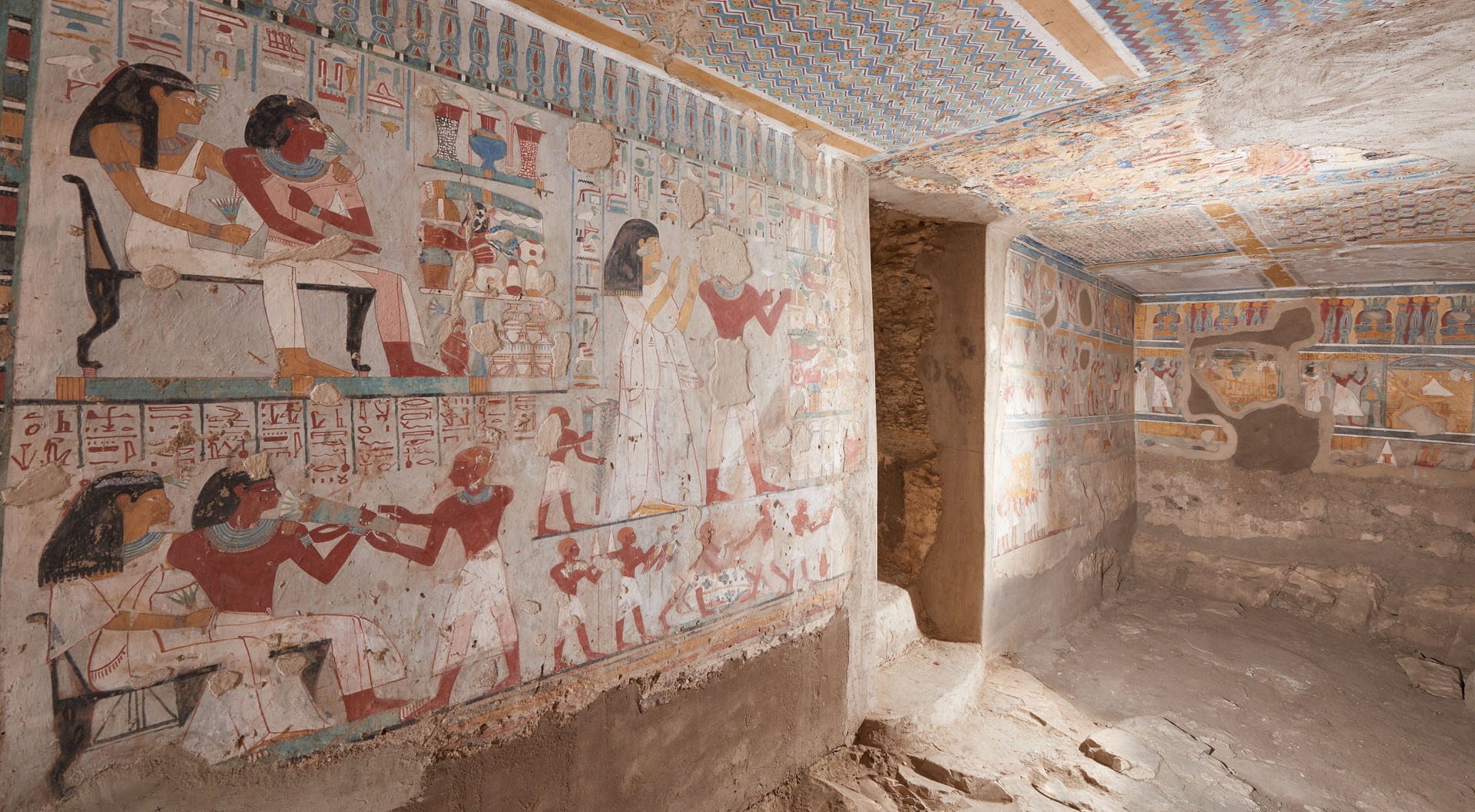
The Dutch Archaeological Expedition to the Theban Necropolis, Luxor West Bank
Mission Director: Dr. Carina van den Hoven (The Netherlands Institute for the Near East, Leiden University)
Funded by: Gerda Henkel Stiftung
The Dutch archaeological expedition to the Theban necropolis was launched by Dr. Carina van den Hoven in 2018 with Theban Tomb 45 as its starting point. Since 2025 the project carries out research and fieldwork in a large area of Lower Sheikh ʿAbd el-Qurna, which comprises Theban Tombs 45, 133, 136, and 137, as well as several unidentified structures which are numbered -290-, -528-, -529-, -530-, and -531-. The main aims of the research and fieldwork project are to implement an extensive preventive conservation and risk management programme, and at the same time to archaeologically study this area. The monuments in this area are extremely vulnerable to flash flooding due to their position at the very bottom of the mountain at Sheikh ʿAbd el-Qurna, and they already show evidence of previous flooding and resulting damage. Flooding of these tombs poses a risk not only to their fragile decoration, but – given the marl content of the tomb structures – also to the stability of the tombs themselves. As a result of climate change, the frequency and intensity of most types of extreme events, such as flash flooding, is expected to increase significantly. For this reason, the project’s conservation programme for the tombs focuses not only on the conservation of the fragile decoration inside the tombs, but also on preventive conservation measures and risk management activities in the area surrounding the tombs, with the aim of protecting these monuments against flash flooding. The tombs in the area of Lower Sheikh ʿAbd el-Qurna are surrounded by high heaps of modern debris which should be removed, and drainage paths should be created in order to effectively and adequately protect the tombs in this area from flash flooding. At the same time, these preventive conservation and risk management activities allow the team to carry out a detailed archaeological investigation of the area of Lower Sheikh ʿAbd el-Qurna, about which currently very little is known. In carrying out research and fieldwork in this area, the team has the unique opportunity to archaeologically study this area for this first time, and at the same time to effectively protect the monuments in this area from flash flooding.
The research and fieldwork project takes a holistic and multidisciplinary approach to all aspects of the monuments of Lower Sheikh ʿAbd el-Qurna and their surrounding environment, by integrating knowledge and techniques from a wide range of fields, including Egyptology, archaeology, conservation, restoration, digital humanities, geology and hydrology, heritage and risk management, etc. Important aims of the project are to develop a proof of concept on the digital documentation and material analysis of the painted decoration of the tombs, and to contribute significantly to the development and application of non-invasive digital technologies to the documentation, publication and accessibility of ancient material culture. An additional aim of the project is to contribute to the scientific infrastructure in Egypt by providing training opportunities to young local conservators, Egyptologists, and archaeologists, as well as to contribute to raising public awareness of the archaeological heritage of Luxor through organising educational and outreach activities for the local community.
The fieldwork project is funded by the Gerda Henkel Stiftung. A proof of concept study on the digital documentation and material analysis of the painted wall decoration of TT45 is sponsored by the Netherlands Institute for the Near East (Leiden University), and the Leiden University Centre for Digital Humanities.
For more information, visit the project’s website.