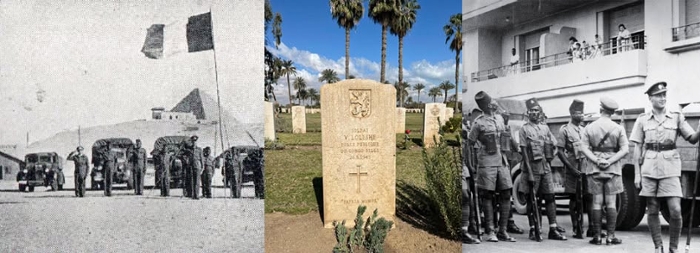
Zana Etambala - Belgian-Congolese Troops in the Nile-region during the Second World War
This lecture will be hosted on Thursday, 29 October 2026 at 6:00 pm.
(A lecture in collaboration with the Belgian Embassy in Cairo)
In this lecture the involvement of the Congolese Force Publique in North Africa on behalf of Belgium during WWII is discussed. When at daybreak on May 10, 1940, the first reports started trickling in in Belgian Congo about the invasion of Belgium by the German armed forces, Governor-General Pierre Ryckmans sent a telegram to King Leopold III, assuring him of the undying loyalty of the entire Congolese population. But the Belgian monarch's decision to stop the fight against Nazi Germany, which was not endorsed by the Belgian government, sparked a controversy in the colony between royalists/neutralists and those who took the side of the government and wanted to go to war against Germany.
Belgian Congo thus became involved in World War II, and on February 6, 1941, three batteries and two brigades of the Congolese army were sent, in very difficult circumstances, to Ethiopia where they were victorious in Asosa (March 11), Gambela (March 23), and Saïo (July 3, 1941). The toll for the Congolese Army was heavy, with dozens of soldiers killed and hundreds more wounded. Several of the former were buried in Egypt.
About the Speaker
Zana Etambala is a Congolese-Belgian historian. Born in the Democratic Republic of the Congo, he moved to Belgium at the age of seven. He studied at KULAK and KU Leuven, where he obtained a PhD in History in 1989. He taught at KU Leuven and has conducted extensive research on Congolese history, with a particular focus on the period from 1876 to 1914. He also served as director of Missio and is currently a researcher at the Africa Museum in Tervuren, Belgium.
A reception will be offered on the rooftop of the institute after the lecture.
This lecture will also be livestreamed on zoom.
Attention!
The lecture starts at 6 pm. The number of seats is limited and we work on a first-come, first-served basis. We open our doors at 5:30 and close them at 6:15 or earlier in case the lecture room reaches its full capacity.