Geert Ham - Sculptures, Symbolism, and Spolia: The Case of the Dromos of the Saqqara Serapeum
This lecture will be hosted on Thursday, 5 November 2026 at 6:00 pm.
At the onset of the Hellenistic period, the Serapeum of Saqqara was already a sizable sanctuary of Egyptian national importance, with a history stretching back to the Eighteenth Dynasty. After the Ptolemies took control of the land of the Nile, they were merely the most recent in a long line of rulers to embellish and overhaul the complex.
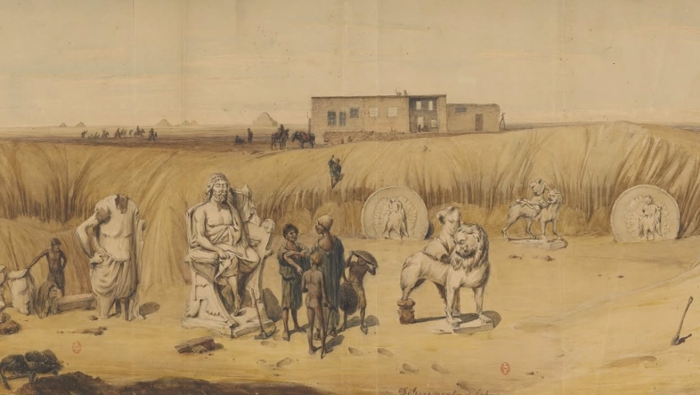
However, when the Egyptologist Auguste Mariette first excavated the temple during the Nineteenth Century, it was the decorative program of the Hellenistic period which most puzzled him. Along the final stretch of the dromos, at the most prominent location of the sanctuary, older statues of the Pharaonic period had been placed among new sculptures in Greek style, depicting such divergent subjects as aging philosophers, winged sphinxes and sirens, and animals mounted by infant boys. At first glance, this eclectic collection of statues appears to be the result of a rather arbitrary selection.
In this talk, Geert Ham aims to re-evaluate the sculptural program of the Serapeum dromos. Was the symbolism of its Greek and Egyptian components truly as unfocused as its original excavator thought? How did such symbolism relate to the role of the sanctuary as a funerary complex of the Apis bulls? And what is the relevance of the way in which this composition integrated old and new statuary?
About the Speaker
Geert Ham is a PhD-candidate at the Institute for History of Leiden University, where he also received his BA in History and ResMA in Ancient History. His doctoral research concerns art and architecture in Egyptian temples during the Hellenistic period, especially the third century BCE, when a mixed Greco-Egyptian artistic style had not yet emerged, but the Greek and Egyptian artistic traditions already stood in close contact with one another. How were temple spaces affected by the side-by-side presence of both traditions? With a strong focus on materiality, he attempts to move beyond the traditional academic dichotomy between Greek and Egyptian.
Attention!
The lecture starts at 6 pm. The number of seats is limited and we work on a first-come, first-served basis. We open our doors at 5:30 and close them at 6:15 or earlier in case the lecture room reaches its full capacity.