
Papyrological Institute
Always borrowing things
Written proof of a loan has always been important. Take a look at examples of loans of grain, wine, and money, and a loan on mortgage.
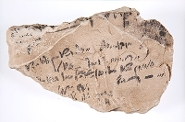
Loan of grain by a priest. Thebes, 3rd-1st cent. BCE
Click here for larger image.

Demotic account of a loan of grain by a lesonis priest, who was the head of the temple administration. The deben is a weight of approximately 91 grams that was used to express the value of commodities. The artaba is a content measure (a large sack) for grain. The wab priest (wab is Egyptian for ‘pure’) is the generic term for priest.
‘The account of the mr šn. The mr šn: 14 (deben); the scribe of the wʿb-priests: 4 deben; the rest of the (?) …, to (the value of) 5 deben: … 23. Classification: Hrj=w: (commodities?) to (the value of) 4 deben; P3-šr-p3-hrt (?), son of Ns-…-iw: … grain (?): making 7 deben; the rest: 16 (deben).
(art. of) barley: 2 ½; (art. of) barley: 4 ½ … (?)
(art. of) barley: 1 ½; (art. of) barley: 1 ¼ (?)
(art.of) wheat(?): 10 + (?)
2; (art. of) barley: 1 (?)’
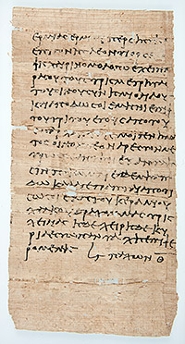
Loan of wine. 27 May 114 BCE (?)
Click here for larger image.
Notary contract. Hermias son of Hermias borrows three metrete s (30 litre vessel) of wine. He will pay them back after two months, the interest being 50%.
Click here for Greek text and translation in DDbDP
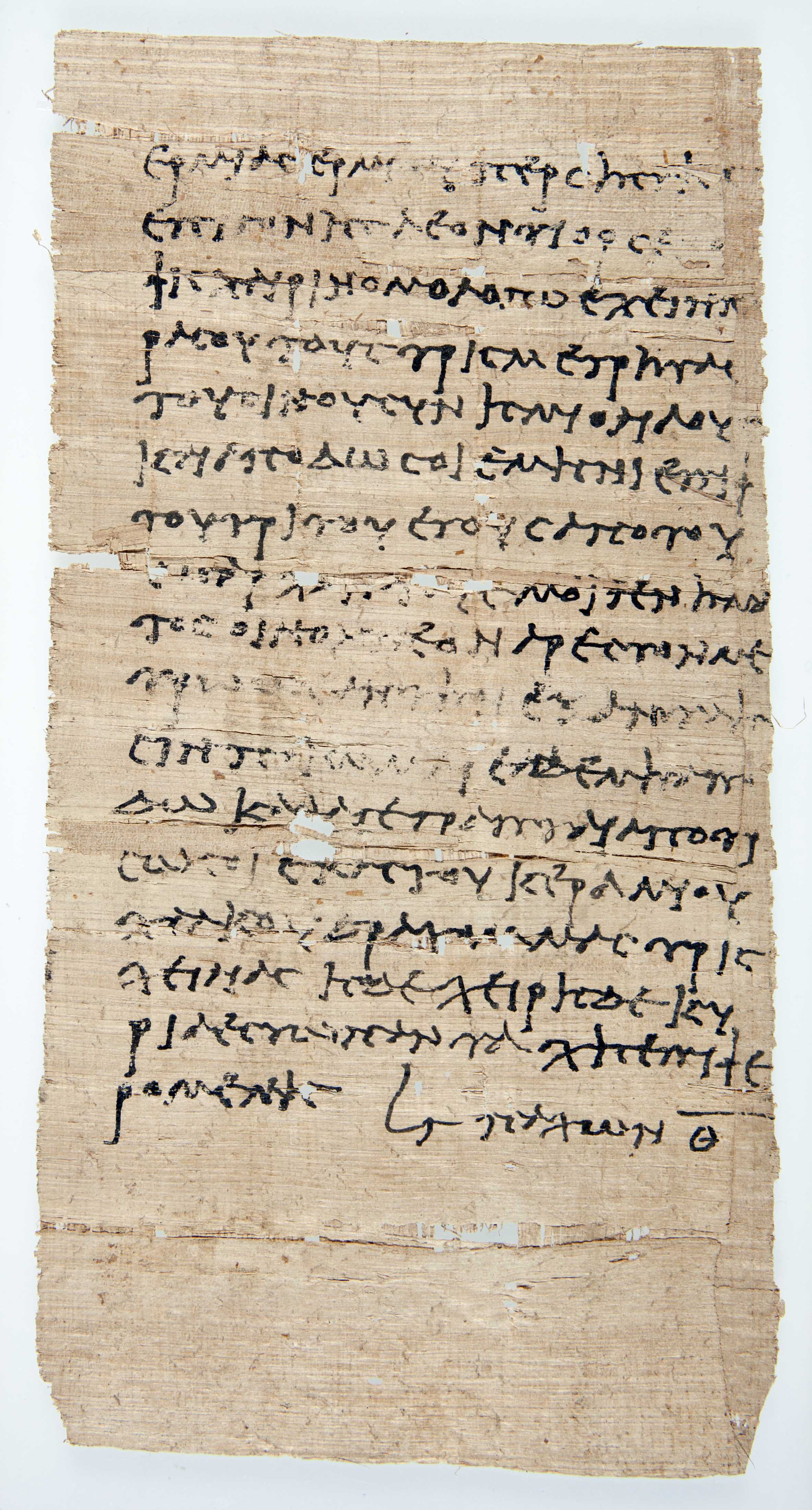
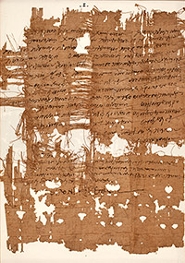
Loan of money. Oxyrhynchos, 14 June 314 AD
Click here for larger image.

This contract was validated by the notary scribe. Roman law allowed women who had three children or more to take any legal action without the otherwise mandatory legal guardian (ius (trium) liberorum). This law was devised by emperor Augustus in order to stimulate population growth. When emperor Caracalla granted Roman citizenship to almost all the inhabitants of the Roman empire in 212 AD, Roman law became applicable to all citizens. The influence of Roman law in Egypt was mostly limited to family law and the law of inheritance, leaving the overall local legal system intact. One other influence of Roman law is the formulaic expression found in most contracts written after 220 AD: “I have given a positive answer to the (formal) question”, which reflects the ancient Roman stipulatio, in which an oral agreement is legally valid. The default interest has not been specified, which suggests that the parties had agreed on a higher amount than the official rate of 1%.
Click here for Greek text and translation in DDbDP.
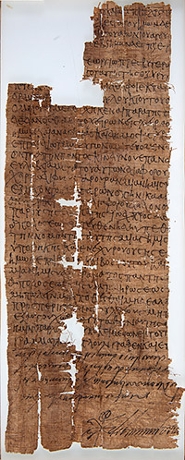
Loan of money secured by mortgage. Oxyrhynchos, 591-592 AD
Click here for larger image.
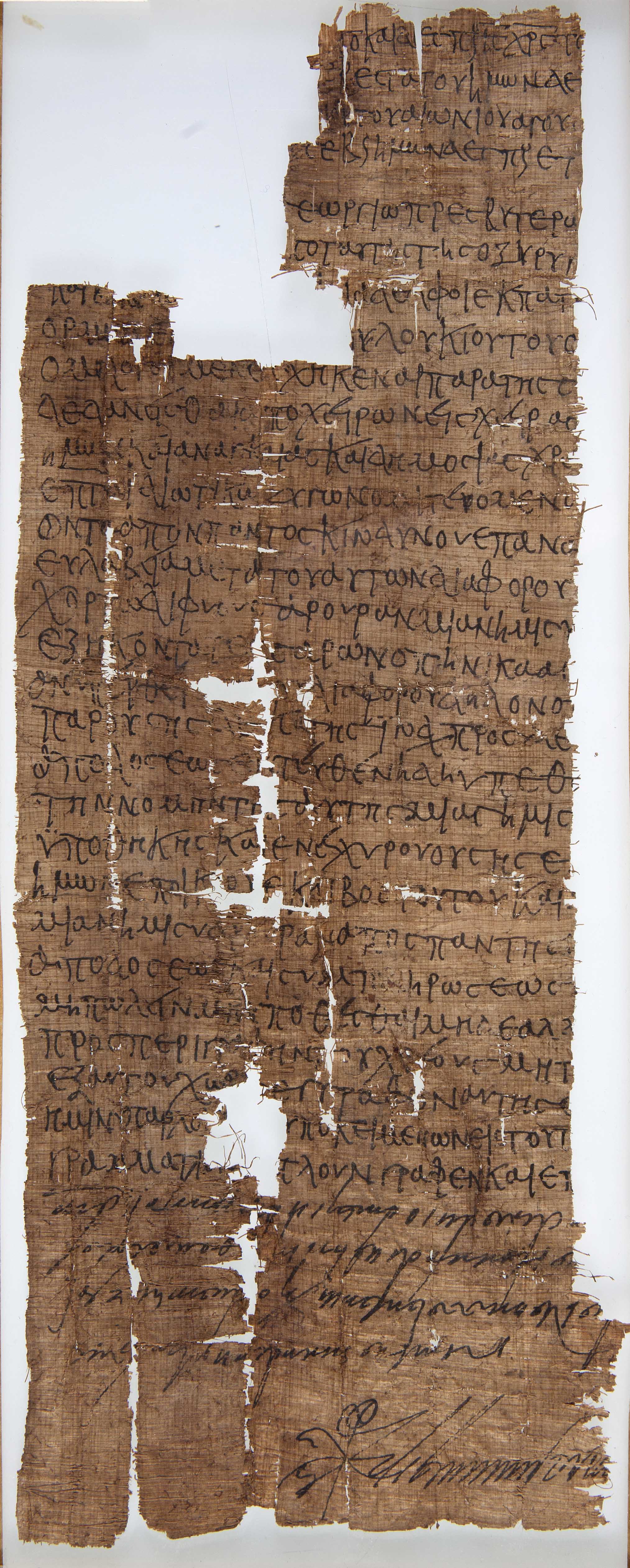
In this late period in Egyptian history legal documents often contain Christian elements such as the cross and the hailing of Jesus Christ at the beginning of the contract. In this case the loan is provided by a priest “of the Holy Church”. Although the content of this contract is similar to earlier loans (albeit that it also mentions a mortgage), the Greek language used and the script are much more exuberant. The right side of the papyrus has broken away. Most emendations (not indicated in the translation) are fairly certain, which is due to the fact that loan contracts contain many standard clauses.
Click here for Greek text and translation in DDbDP.