
Week 5b: 5-7 February 2026
After surviving a bumpy bus ride yesterday, everyone woke up feeling more or less refreshed in Aswan. Being here made us really understand the importance of the Nile in the lives of the ancient Egyptians. Everywhere we go, all the sites we visit, every dinner we eat, the Nile is everywhere.
Our first day in Aswan started with a visit to Elephantine, where Dr. Martin Sählhof gave us a tour of the site. He immediately told us that Elephantine concerns the settlement, and not the island, as it is often referred to in scholarly literature. We will not be making that mistake! Walking around the settlement, we got to experience the difficulty that is the stratigraphy of Elephantine. The main road dividing the two parts of the town illustrated this perfectly: we entered it at the Old Kingdom level and climbed all the way up to the Late Antique level, where we had an amazing view of the area. The last stop of our tour was a 3rd Dynasty step pyramid, which we, as true students of Egyptology, had to get a close look at.


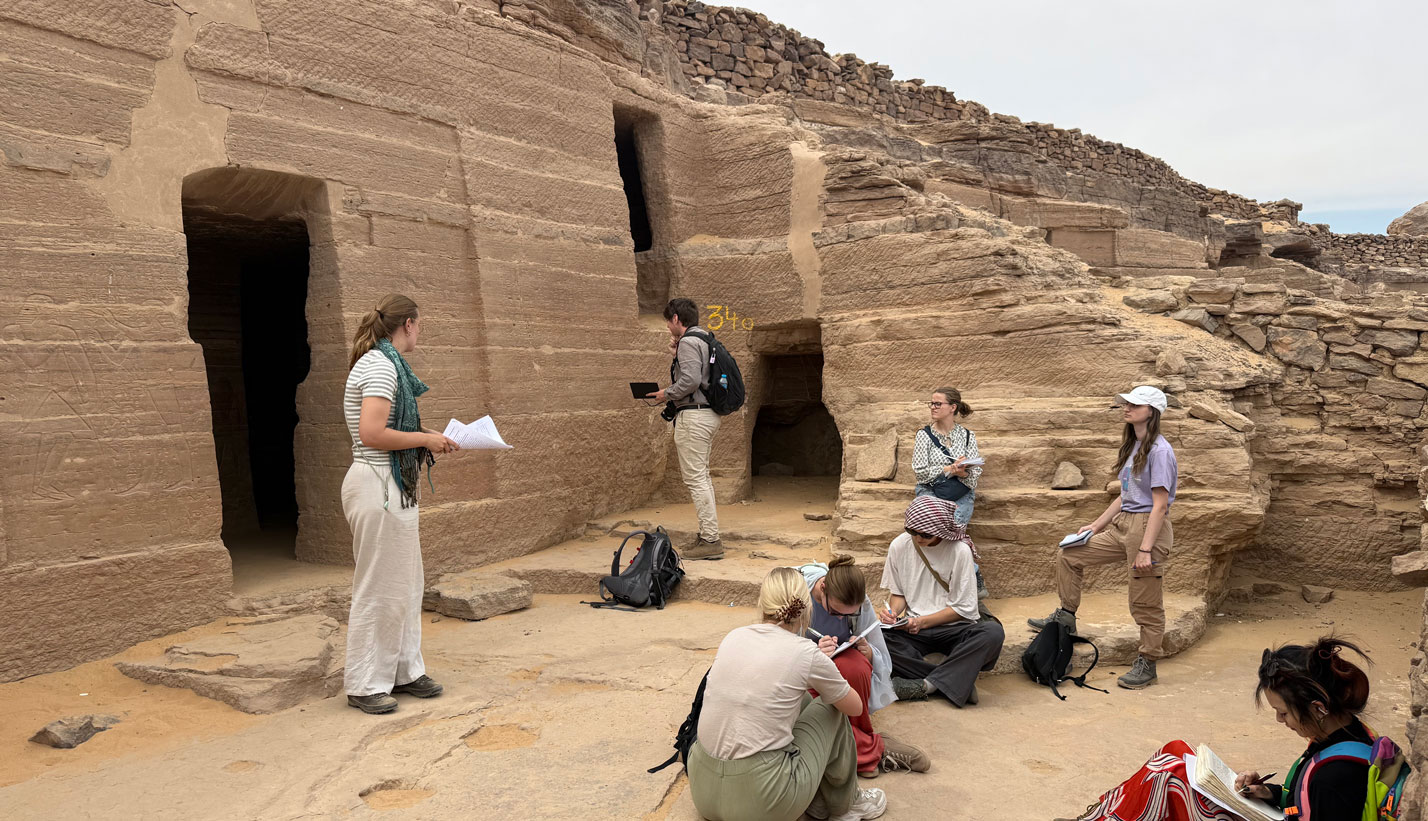
After witnessing the Giving-of-the-cheese-ceremony for the last time, we went to Qubbet el-Hawa, where Luna gave her site presentation on the tomb of Harkhuf. Harkhuf, a 6th Dynasty official, undertook four expeditions to Nubia, three of which are mentioned on his tomb. The letter from Pepi II was also there in its full glory. For many of us, the texts on the façade of the tomb were our first introduction to Old Egyptian, so it was a true full-circle moment. After Luna’s presentation, we got to explore the other tombs in the area, and even went to the shrine on top of the mountain. Fortunately, we did not encounter any trap doors or big, moving boulders. Some of us did end up in a breakdance battle somehow.

On Friday, we got to explore Sehel Island to our hearts’ content. Many officials involved in expeditions to and from Nubia left inscriptions on the rocks there. Some of us turned into real mountain goats, determined to find as many inscriptions as possible. Of course, a hike up to the Famine Stela could not be avoided, just like the group selfie that followed the hike.

After living our best lives looking for treasures (inscriptions), we got to cool off in the Nubian Museum. Seeing the Dream stela in real life was a dream come true for us. Wandering around the museum looking at cool pots and jewelry, some of us even managed to spot a very tiny frog.
The afternoon was either spent relaxing in the hotel or, for the brave ones among us, on a felucca. We watched the sun go down behind the shrine on top of Qubbet el-Hawa, where we had just been the day before. The view was made even more amazing by the music, courtesy of our very own DJ Zoé, assisted by DJ Jana.

Our last day in Aswan was spent at the Temple of Philae, where Diego gave his site presentation. The temple was relocated during the UNESCO campaign, when also the Temple of Taffeh came to Leiden. The Temple of Philae was mainly dedicated to the goddess Isis, although there was a mammisi for Horus the Child as well. The temple was later reused in the Coptic period. The morning was spent admiring the architecture, the inscriptions, and the temple cats (every temple in Egypt has to have at least one temple cat). Some of us were not done with hunting for inscriptions, even after Sehel Island, and set out to look for Demotic, Coptic, Greek, and Arabic graffiti in the temple. Our next stop before lunch was the Unfinished Obelisk. We do not envy the workmen who caused the cracks in the obelisk.

After having a very good plate of gnocchi for lunch, it was time to head to the train station, from which we took the sleeper train back to Cairo. Before going to bed, we got out all our energy by dancing to ’t Smidje and the Macarena. Yalla yalla to Cairo!

Lena Siegmann