
Adventures of a NWIB Visiting Professor in Cairo
Since mid-October Marina de Regt (VU Amsterdam) resides at NVIC as our 2025 NWIB Visiting Professor. Nearing the end of her time in Egypt, she shares here her experiences of the past months.
My time at NVIC
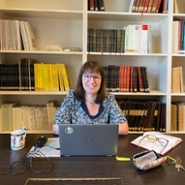
In the past two months I was the NWIB Visiting Professor at the Netherlands-Flemish Institute in Cairo. Specialized in the anthropology of contemporary Yemen, and in particular gender and migration issues, Egypt might not be the first country one thinks of as a suitable site for research. However, after the outbreak of the war in 2014/2015 in Yemen many Yemenis have migrated to Cairo. Exact numbers are not available but estimations are around 100.000.
When I applied for the visiting fellowship I mentioned that I wanted to do preliminary fieldwork among Yemenis and finish a number of publications. Upon arrival mid-October I first started writing. I had a deadline for a chapter in an edited volume on 6 November, and had not done anything about it yet. I even thought of withdrawing from the book project. However, the quiet environment at the institute inspired me a lot and within three weeks the draft chapter, in which I describe the ways in which four Yemenis of mixed Yemeni-African descent living in the diaspora embrace their identities publicly in podcasts, memoires and art work, was finished and submitted. I wrote every day and explored Cairo in the afternoons and evenings.
After this, I continued with the revision of a manuscript about my friendship with a Yemeni woman over the course of three decades and the increasing role money played in it, caused by the war. Jurgen Maas, a Dutch publisher, had given me extensive feedback. I sent the revised manuscript to him on 30 November, two weeks earlier than planned.

In the first month of my stay I had not made many contacts with Yemenis. I visited Yemeni restaurants, as there are many in Cairo, and attended the Yemen Exchange, an online course about Yemen and Yemeni politics in particular, organized by the Sana’a Center for Strategic Studies. The course took place on Monday and Wednesday afternoons for four hours. It was a very informative and intensive course. While I was not yet meeting Yemenis in real life, I gained a lot more understanding of the (geo)political situation. As someone who in the Netherlands is seen as a “Yemen expert”, I learned a lot about the highly complicated situation in the country. It depressed me at times but meeting so many Yemeni experts online and people committed to improving the situation in the country inspired me as well.
When the manuscript was sent off, I started reaching out to Yemenis. During a conference on displaced Sudanese in Cairo, which took place at the French Institute mid-November, I had heard about Faysal, the area where many refugees among whom many Yemenis live. During my first visit to Faysal I met Mohamed Saba, the owner of a Yemeni bookshop and cultural center. Walking through Faysal I saw Yemeni groceries, bakeries, and cafés, and people responded enthusiastically when they heard that I spoke Yemeni Arabic and had lived in Yemen.

A day later I went to the Yemeni Cultural Center in Dokki, where weekly events such as exhibitions and music performances take place. I met many Yemenis and was invited by the center’s vice-director Nebil Subaye to present my experiences living and working in Yemen. This presentation took place on Monday 1 December. I showed many pictures of “beautiful Yemen” and spoke for about an hour in Arabic to an audience of around 30 Yemenis. The lively discussion was moderated by Mazen Hamdain and we listened to a performance of two Yemeni musicians, an oud player and a singer. Many people came to me afterwards. They were very happy with the way in which I shared positive memories of their country, a country which is nowadays mainly regarded as a war zone. My network grew.
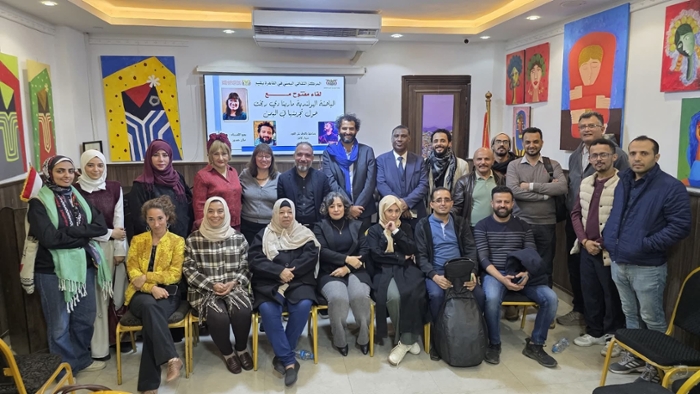
On 4 December I gave a presentation at NVIC. The title was “Yemen Beyond Borders: Migration, Mixed Identities and Social Change.” I presented my ongoing research about Yemenis of mixed Yemeni-African descent, and could use the chapter I wrote in the beginning of my stay in Cairo as point of departure. There were about 20 people and quite a number of interesting questions afterwards.

On 12-13 December I organized a very small workshop to develop a larger research proposal for the Dutch organization for scientific research (NWO) on Yemenis of mixed descent in Egypt, Saudi-Arabia and Djibouti. Two of the three intended post-docs came to Cairo, we met a number of Yemenis interested in the topic, amongst who Mohamed Saba and Nizar Ghanem who wrote a book about “Yemeni-Afro” culture, and paid a field visit to Faysal.
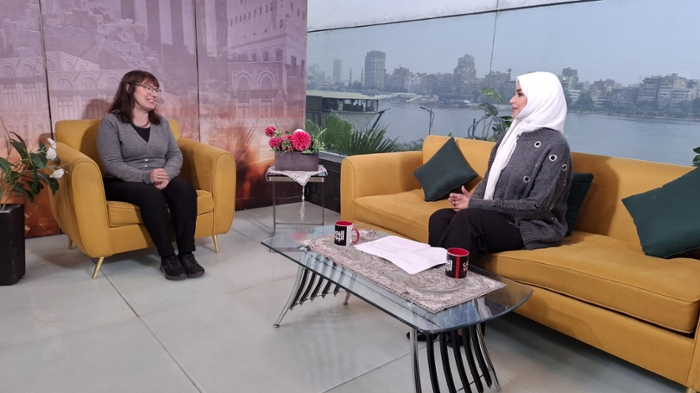
As a result of my presentation at the Yemeni Cultural Center I was invited to speak about my experiences in the Yemeni TV-programme “Yemen Today”. It was broadcasted live. A few days later the same channel recorded a longer podcast which will be broadcasted in a few weeks.
Yemenis are clearly in need of positive stories about their country, and excited when they meet a foreigner who has knowledge and experience of their country in better times. My stay at NVIC has therefore been extremely useful: it has given me the chance to finish a number of publications about Yemen that needed inspiration and concentration. Moreover, it has inspired me to continue working with Yemenis on issues that they see as relevant.
Marina de Regt, Cairo, 16 December 2025
2025 NWIB Visiting Professor