Leiden University’s two-year MA Japanese Studies offers a unique opportunity to conduct graduate-level research on various aspects of modern and pre-modern Japan, and to spend a full academic year in Japan.
Why study Japanese Studies at Leiden University?
The two-year MA Japanese Studies offers an immersive experience that goes beyond the classroom. At Leiden, you will join a state-of-the-art and multidisciplinary programme taught by leading academics in the field. Our program is designed for a select group of talented and highly-motivated students who wish to engage into specialised research on various topics in Japanese studies, such as contemporary society, politics, art history, classical and contemporary texts, and linguistics. Recent student thesis projects focused on Japanese martial arts, political discourses on transgender identities in Japan, student activism and gender representations in Shunga.
Study in Japan
A highlight of the two-year programme is that two semesters of your degree will be spent studying at a university in Japan, offering you a once-in-a-lifetime opportunity to immerse yourself in Japanese culture, language, and society, take courses on topics of interest at a leading Japanese University, and conduct on-site research for your MA thesis. Develop your fluency in Japanese and gain a host of skills and insights that will prepare you for real-world success after your master's degree.
"Studying contemporary Japanese society is like a journey: full of discoveries and new insights. It is not just a question of acquiring knowledge, but reflecting on issues relevant to our own lives. My classes on contemporary Japanese society address, for instance, gender inequality in contemporary Japan. What explains the persistence of gender inequality in the workplace in Japan despite the existence of laws ensuring equal opportunities? Engaging with these kinds of questions means developing not only a better understanding of Japan, but reflecting on the meaning and significance of gender, and how gender operates on a societal and personal level."
What are your career prospects?
Our alumni can be found working within Japanese multinationals such as banks, insurance companies, and government bodies. Others have followed paths into consultancy, management, journalism, PR and marketing, tourism, and education. Our alumni can be found working at international organizations and Japanese companies, whilst others have followed paths into consulting, media, PR and marketing, tourism, education, and more.
A comprehensive range of topics in modern and pre-modern Japan combined with a flexible programme format mean that you can tailor your studies to your interests and career goals. Alongside your specialised knowledge, you will acquire analytical and critical-thinking skills and the ability to independently conduct high-quality research.Do you want to find out if you are eligible for this Master's Programme?
During my stay in Japan, Japanese language classes were part of the curriculum that I followed at the university there. It was a fairly intensive programme, and I learned a lot from it, but I also found that it is important to make sure that you leave space for other subjects. In terms of Japanese language skills, you ultimately learn the most by using it in your everyday life there anyway! Read more.
A centre of expertise on languages and cultures of the world
If you’re interested in languages and cultures, Leiden University is the best place to study. The university’s global expertise places our programmes at the top. In Leiden and The Hague, we study languages and cultures from all regions of the world and from prehistory to the present day. In this way, we create a broad view of the world; the key to mutual understanding.
Video: Our experts on Languages and Cultures explain
Due to the selected cookie settings, we cannot show this video here.
Leiden University offers ambitious students the world-class environment needed to reach their potential.
Top-ranked university
Leiden University's Faculty of Humanities consistently ranks among the top 30 humanities faculties worldwide by the Times Higher Education (THE) World University Rankings. Here, you can access resources found nowhere else in the world, such as Leiden University's famous collections of Asian artefacts; learn from researchers whose expertise spans all corners of Asia; and choose from an expansive curriculum that includes specialised subjects not available elsewhere.
Close, individual tuition
At Leiden, we take a student-centred approach to learning. Teaching takes the form of small-scale lectures, seminars and tutorials, where every student has the opportunity to participate in debates and share their ideas. A high level of focused attention from lecturers also keeps you engaged and on track to meet your goals. A flexible programme format means that whatever your interests or career goals, our faculty members can help you customise the programme to meet these requirements.
Access to the Humanities Hub labs
As a Humanities master’s student you will have access to the Humanities Hub which comprises labs with digital facilities for both students and researchers. The labs include an AI Lab, Media lab, film studio and podcast studio and give you the opportunity to develop your digital and media skills within the field of the humanities. Check the Humanities Hub page for a full list of all the labs and facilities.
Humanities Hub Leiden
An excellent start to your career
Our reputation as a centre of excellence means that your qualification is respected by organisations worldwide. Our graduates enjoy successful careers thanks to their broad and global mind-sets, specialised and in-depth knowledge, and strong critical-thinking skills.The success of our alumni speaks for itself: our graduates are equipped to solve the challenges facing society now and in the future.
Diversity and inclusion
We are convinced that our education can only flourish if everyone within the programme feels supported, respected and empowered to do their best work. We find it important to offer a learning environment that allows for different perspectives and points of view that students bring with them, depending on their ethnicity, gender, sexual orientation, health, religion, age or socio-economic background. Every new generation sees the world from a new perspective – and our students are the newest generation. We look forward to hearing more about your perspective. Leiden University has been pursuing diversity policy since 2014, with the aim of creating a diverse and inclusive learning and working environment for all staff and students.
Due to the selected cookie settings, we cannot show this video here.
The two-year master's programme in Japanese Studies, a specialisation of the MA in Asian Studies, offers teaching by leading academics and a multi-disciplinary approach to the study of the East Asian region.
Mastering the Japanese language
A central focus of the two-year MA Japanese Studies is on mastering the Japanese language. Your fluency in Japanese will complement the knowledge you develop in other disciplines, which you will select from the wide range of academic perspectives available at Leiden. These academic disciplines include history, philosophy, religion, literature, politics, sociology, anthropology, linguistics, genderstudies, and many others.
Programme structure
Semester 1: Leiden
The first semester and the first block of the second semester of the programme is held at Leiden and consists of the following courses:
The core course Introduction to Asian Studies that explores the place of Asian Studies in the larger field of Area Studies and among the many disciplines represented in Asian Studies;
Two electives from the Japanese studies specialization;
Advanced Japanese I and II.
You have to reach at least the equivalent of JLPT level 2 in Japanese in order to follow courses at Japanese universities. Students who do not reach the required level by March, will not be allowed to progress to the year in Japan.
Semester 2 and 3: Japan
Two semesters of your degree will be spent studying at a university in Japan, where you will follow relevant courses in your chosen field of research and conduct research for your MA thesis. The purpose of the year abroad is to strengthen your language skills, to conduct academic research at a university in Japan, and to develop your understanding of the country and its society.
The Faculty of Humanities offers a partialscholarship for the year in Japan for each applicant who has been admitted to the programme. This is not a full scholarship but only a partial contribution to your expenses in Japan.
Semester 4: Leiden
In the final semester in Leiden, you continue working on your thesis research, and take am advanced language classes.
Our goal is that, by the time you are ready to write your MA thesis, you will be in a strong position to integrate your language and academic skills to the point where you can use primary sources written in Japanese as part of your research.
For a more detailed programme, see the Prospectus.
Please note that this guide applies to the current academic year, which means that the curriculum for next year may slightly differ.
Admission and Application
Do you want to find out if you are eligible for this Master's Programme?
Get the most out of your studies at Leiden University by taking part in our extracurricular activities.
Asian Studies study associations
The MA Asian Studies’s study association: A.S.I.A (Asian Studies International Association) organizes a range of activities and provides a community for our students. You can find their Instagram page here. The program also collaborates with the study associations of the BA programs in Asian Studies: Siitaa (South and Southeast Asian Studies), SVS (Chinese Studies), LVSJK Tanuki (Japanese Studies), and S.V.K. Dokkaebi (Korean Studies) and the BASIS East Asia Committee (International Studies). These associations organise educational and social activities such as parties and film nights, lectures, company and career days, workshops and much more. Joining a study association is a great way to get to know fellow students and teachers outside of the academic setting.
Leiden Leadership Programme
If you’re interested in developing your leadership potential, the Leiden Leadership Programme offers training sessions, seminars, and a Personal Leadership Roadmap to help you grow.
Study at the Academy of Creative and Performing Arts
The Academy of the Creative and Performing Arts (ACPA) is a research institute and part of the Faculty of Humanities. The ACPA offers education such as electives, and talent programmes such as the Practicum Artium (PA), which gives you the opportunity to study photography, graphic design or drawing, and the Practicum Musicae at the Royal Conservatoire The Hague, where you can study classical music, singing, early music or jazz. Find out more about ACPA.
Due to the selected cookie settings, we cannot show this video here.
I have always been interested in the art world. As having artists as parents, I spent much of my childhood in museums and galleries. While completing two bachelor’s in Japanese studies, one in Leiden and one at Hokkaido University, Japan, I have always chosen art subjects as my electives. This made the opportunity presented by my teacher during my master to do an internship at the Rijksmuseum a dream come true.
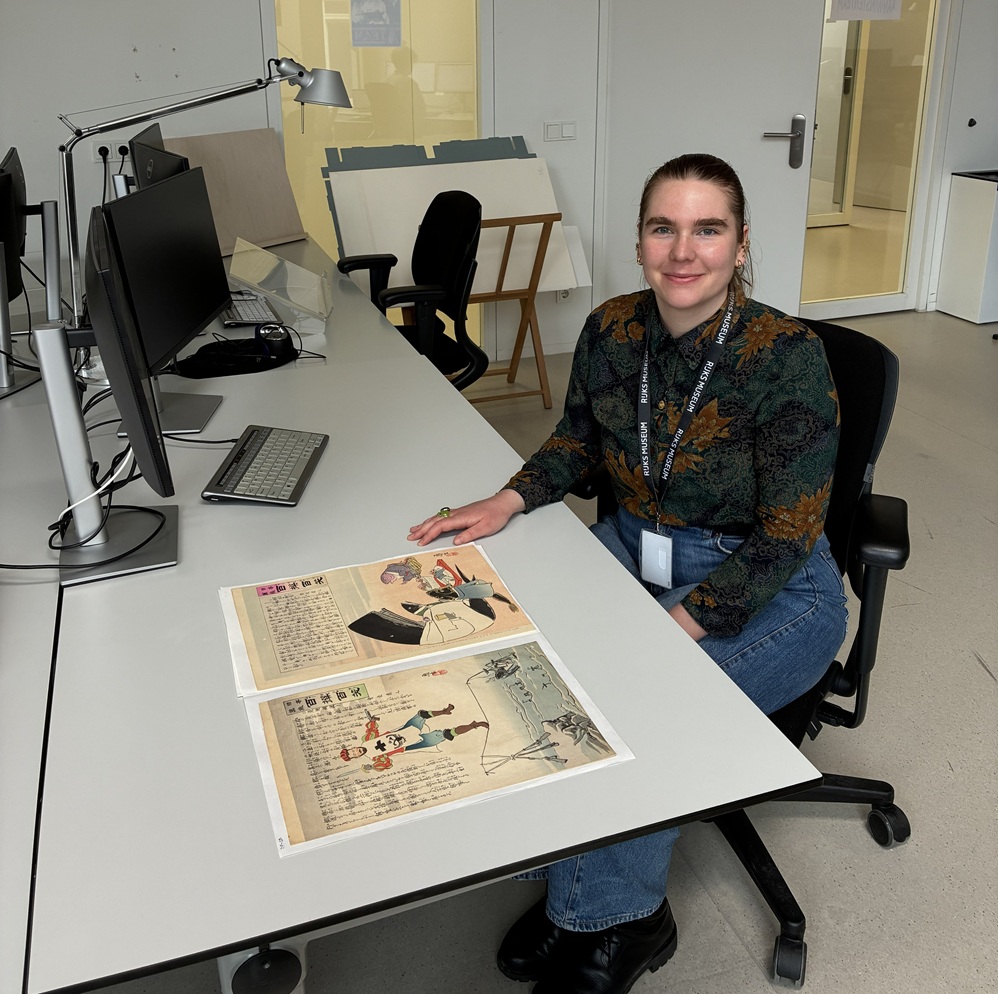
What is your role at your internship at the Rijksmuseum? I do independent research on a collection of Japanese prints. To gain an idea of the prints, I first measured them and translated the titles. Moreover, I help the curator of Japanese prints Marije Jansen. This also makes me experience the work a curator does firsthand.
"Doing research on prints firsthand has taught me a lot. So much of what I have learned studying Japanese I can apply while doing this internship."
How do you use the knowledge and skills you learned during your master’s in your internship? As I am working with Japanese prints I use my Japanese language skills, knowledge of Japanese art and cultural knowledge. The titles of the prints have often a double meaning and a hint to cultural practices or even theater forms. This makes me apply knowledge I picked up during my studies.
What do you enjoy most about your internship? The combination of both being part of the acquisition team and working with a curator has been very enlightening. Also, having the prints in front of me and being able to study the prints up close has been great.
What did you learn from this experience? I have learned about different functions at the Rijksmuseum and the work a curator does. Also doing research on prints firsthand has taught me a lot. So much of what I have learned studying Japanese I can apply while doing this internship. Both cultural knowledge and language skills are of the essence.
Do you have any recommendations for other Asian Studies students or prospective students who are interested in doing an internship at a museum? It is important to keep your ears open and tell your teachers that you would love to do an internship. They often have more connections and as was the case with me could be able to get you in touch with a curator at a museum. Moreover, if you can do something you like do not hesitate and try it.
Jona in Japan
Jona Boekesteijn: My year in Japan
During my stay in Japan, Japanese language classes were part of the curriculum that I followed at the university there. It was a fairly intensive programme, and I learned a lot from it, but I also found that it is important to make sure that you leave space for other subjects. In terms of Japanese language skills, you ultimately learn the most by using it in your everyday life there anyway!
Of course, in addition to the fact that my Japanese language skills have improved tremendously, I have also been able to learn other subjects. But, perhaps more interesting is that I have also learned a lot about self-reliance in a completely new environment. How do I take care of all sorts of affairs at the ward office, what is the student culture like in Japan and how do I involve myself in it, how do I balance daily life, sightseeing and university? I think I have grown considerably as a person.
"In terms of Japanese language skills, you ultimately learn the most by using it in your everyday life there anyway!"
If I had to give advice to new MA students it would be something like this: I was rather nervous about applying for this Master’s programme because I thought that it was only meant for top students, and also because a year in Japan seemed quite intense to me. You really don't have to worry about that first thing, if your motivation is in order and your Japanese is good enough to pass the language courses in Leiden, you are more than ready. And yes, a whole year in Japan may look daunting and it was certainly not always easy, but for me it turned out to be an experience that I wouldn't trade for anything.
One last tip: when selecting your Japanese university, double-check if they have any additional requirements for things like courses in Japanese or how many language courses you would be doing!
Ivo Smits is a professor of Arts and Cultures of Japan at the Leiden University Institute for Area Studies (LIAS). His research focuses on early medieval classical texts in both classical Japanese and classical Chinese. View his full profile here.
Dr. D. Müller
Doreen Müller is a historian of the visual arts and material culture of Japan. My research addresses the interaction of images and text in the narrative scroll tradition and in printed media in early modern Japan. View her full profile here.
Dr. K. Yoshioka
Keiko Yoshioka is a Lecturer at the Leiden University Institute for Area Studies and Head of the Japanese language programme. She is interested in how the knowledge of learners’ L1 (mother tongue) and L2 (the second, third etc. language(s)) possibly interact in various L2 situations. View her full profile here.
E. Yamamoto MA
Emi Yamamoto is skills lecturer at the Leiden University Institute for Area Studies. View her full profile here.
Dr. E. Mark
Ethan Mark specializes in modern Japanese history, with particular expertise in Japanse imperialism and the social and cultural history of the 1920s-1940s. View his full profile here.
Dr. A.E. Ezawa
Aya Ezawa is a sociologist and University Lecturer in Modern Japan studies. View her full profile here.
Dr. A. Giolai
Andrea Giolai is University Lecturer Ethnography and Performing Arts of Japan at the Leiden Institute for Area Studies. View his full profile here.
Dr. T.J. Laméris
Tim Laméris is a university lecturer at the Leiden Institute for Area Studies (LIAS) and the Leiden University Centre for Linguistics (LUCL). View his full profile here.
Our alumni can be found working at international organizations and Japanese companies, whilst others have followed paths into consulting, media, PR and marketing, tourism, education, and more.
Examples of the diverse roles of our graduates include:
Account Manager at Asahi Intecc, a Japanese company that develops metal wire for medical applications
Analytics Assistant at Reed Elsevier, a provider of information services
Area Manager Asia at the Netherlands Council for Trade Promotion
Marketing Trainee at Wakibi microcredit, a provider of microcredit
Service Management Consultant at a company developing software
Junior Project Manager at Concorde Group BV, a translation agency
Coordinator, International Relations at Mima City Hall
Consular Officer at the Dutch Embassy in Japan
Translator and Product Developer at Kobe Bussan, a business supermarket
Corporate Banking Assistant at Bank of Tokyo-Mitsubishi UFJ
Research Master
If you have ambitions to pursue a PhD position or career as a researcher outside of academia, you can apply for the two-year Research Master in Asian Studies on completion of the programme.
Anna: My internship at the Rijksmuseum
I do independent research on a collection of Japanese prints. To gain an idea of the prints, I first measured them and translated the titles. Moreover, I help the curator of Japanese prints Marije Jansen. This also makes me experience the work a curator does firsthand. Read our interview with Anna on the Student Experiences page.
Christiaan Raaijmakers
Senior sales manager
"I work as an international sales manager for a French company that manufactures seats for theatres, cinemas, auditoriums, and conference halls worldwide. I travel around Northern Europe and Japan, where I meet with architects and owners of such venues and offer the company’s top-quality products. The French company is part of a Japanese-owned company group. The head company of this group is Japanese and I attended an internship there in 2014. "
Becoming a link between Japan and Europe
"A few months ago, they offered me to come and work for their French company. Now, I act as a link between the French company and Japanese company due to my knowledge of the Japanese language and culture that I gained during my Master Asian Studies. At the time, I chose the two-year Master Asian Studies – Japanese Studies to be able to study more about the country I grew to love. It also provided me with an exchange program to study the language and culture at one of Japan’s top universities for one full year. With help from this Master programme, I have achieved my goal of becoming a link between Japan and Europe."
In which sector do students find jobs?
14 %Art and culture
14 %Healthcare and wellbeing
14 %IT
14 %Industrial
14 %Government and semi-government
14 %Wholesale and retail
14 %Education
This graph is based on alumni data from the MA Japanese Studies 2020 through 2024.
Career preparation
Find out how this programme exactly prepares you for your future career and check our career preparation activities.
Knowledge and skills
Launch your career with a master’s degree
Continuing your studies after your bachelor's degree pays off. Graduates with a master's degree are more likely to find higher-level positions: 77% start at a university of applied sciences (hbo) or university level, compared to 63% of graduates who only hold a bachelor's degree. This difference remains visible in the long term. After more than two years of work experience, 87% of master's alumni work at a university of applied sciences or university level, compared to 76% of bachelor's alumni.
A unique strength on the job market
As a Humanities graduate, you have developed talents that are in high demand on the job market. Intercultural skills, written communication, and social awareness are qualities that clearly distinguish Humanities graduates on the job market. Your ability to think analytically and creatively also gives you an edge.
Internships
Do you consider putting your knowledge into practice during your studies? Determine whether an internship could be an option for you. Start orientating your possibilities by visiting an internship information session. This way you can receive information about the internship procedure and listen to tips of former interns.
Notice that you will search for an internship yourself to find a place of your interest. Do you need some help with this or the application process? Do not hesitate to contact the Career Service. When you have found an internship, inform us. Then, the internship coordinator advises you how to proceed and provides your internship plan with feedback so it can be submitted for approval to the board of examiners.
Humanities Career Service
Due to the selected cookie settings, we cannot show this video here.
Our staff can help you identify both the career that is right for you, and the necessary steps to get you there. Our team at the Humanities Career Service provides all Leiden University Humanities students with professional advice and guidance on everything from internships and career planning to job applications. The Humanities Career Service also organises regular workshops on topics such as effective interview skills and creating a successful CV. Check our video and hear from our alumni how they have benefited from our services!
The Leiden University Career Zone is an online career portal that helps you to prepare for the job market. Here you can find information, tools and tips to help you gain more personal insight, learn about the job market, develop your application skills, plan your academic and professional career, find job vacancies and discover what the Career Service can do for you.
Ask Alumni: Leiden University Mentor Network
Join the Mentor Network to contact alumni with experience on the labour market and ask them for advice. More than 1200 alumni are happy to help you!
Jelle on finding an internship via Leiden University's Mentor Network
Due to the selected cookie settings, we cannot show this video here.
Find out how to apply for Japanese Studies (120 EC) at Leiden University by following our step-by step guide.
This specialisation is part of the MA in Asian Studies. If you would like to apply to this programme please first select the MA Asian Studies (CROHO code: 60840) in Studielink and then select Japanese Studies (120 EC).
Step-by step guide
This guide clearly explains the steps you need to take to apply, and the subsequent admission process.
To be eligible for Japanese Studies (120 EC) at Leiden University, you must meet the following admission requirements.
Diploma requirements
General diploma requirements
You are eligible to apply for the MA Asian Studies: Japanese Studies (120 EC) if you have:
A bachelor’s degree from a research university, equivalent to the level of a Dutch academic Bachelor’s degree;
Knowledge of the nature and role of as well as the ability to analyse and report on academic inquiry in the humanities or social sciences; and
Completed components at bachelor’s level (which may include the thesis) equivalent to at least 30 EC (or equivalent) on at least three out of these six disciplines: history, art, culture, politics, society or economy of one or more East Asian countries or regions.
Fundamental knowledge of pre-modern and modern Japan.
Knowledge of japanological traditions and understanding of disciplinary-methodological issues.
Sufficient command of Japanese, at JLPT 2 level, with a maximum of level JLPT 1.
Please note that because an important distinguishing aspect of the programme is advanced language acquisition in Japanese, this specialisation is not suitable for native speakers, and persons with near-native fluency and a BA or MA degree from a Japanese university.
Qualitative admission requirements
In addition, you also have to meet the following qualitative admission requirements:
Good grades comparable with an average mark of at least 7.0 (Dutch grading system) for the entire bachelor’s programme, and a grade for the bachelor’s thesis of a 7.0 or higher (Dutch grading system), and
Demonstrable motivation to study and suitability for the particular MA programme/specialisation, and
Good academic writing skills: the ability to write a well-structured essay/paper on a topic in the specific field of the specialisation in English.
How to meet the qualitative admission requirements
A good academic record must be shown by a transcript of records/grade list (including the grade of the Bachelor’s thesis and/or average grade).
Your motivation should be demonstrated by a well-argued and structured motivation letter in which you indicate why you want to follow the MA programme, and show clear understanding of the content of the study programme, specifically listing two courses of the current study programme (from the Prospectus) and explaining why these appeal to you. The statement should be between 700 and 1,500 words.
Good academic writing skills should be demonstrated by a Writing Sample. You should submit a 1,250 word essay as part of the admission process:
in this essay you must demonstrate a clear affinity with and specific knowledge of Asian studies in general and specifically in the field of the specialisation for which you apply,
specifically, the essay must clearly answer a research question, provide an argument that demonstrates a satisfactory understanding of the topic of the essay.
Two letters of reference, of which at least one by an academic member of staff.
Bachelor’s degree of a university of applied sciences (hbo)
Applicants with a degree from a Dutch university of applied sciences (hbo) or equivalent are not eligible for admission to the Master’s and pre-master’s programme.
Language requirements
English language proficiency
The following requirements apply*:
IELTS Academic modules only, on paper or on computer: 6.5 overall, with at least 6.0 for each separate component score.
We do not accept IELTS General Training, IELTS Indicator, or IELTS One Skill Retake
TOEFL internet based: 90 overall, with at least 4.0 (new 1-6 scale as of 21 January 2026) or 20 (old 0-30 scale) for each separate component.
We are not able to accept The TOEFL IBT Home Edition™, except in the following situation only:
You are unable to take an in-person test on location because test centres are inaccessible or closed due to unsafe conditions in a country.
We do not accept the following types of test: TOEFL My Best™ scores (multiple test scores combined), TOEFL Essentials™ or institutional tests such as ITP.
Cambridge English Exam C2 Proficiency, or C1 Advanced (180), with a minimum score of 169 for each separate component.
Note that English test results may not be more than two years old and must be obtained in one single test.
* New TOEFL grading scale 2026 In January 2026, TOEFL introduced a new grading scale. Test certificates issued in 2026 and 2027 will show overall scores in both the old grading scale (0-120) and the new grading scale (1-6). Component or band scores will only be shown in the new grading scale.
Leiden University’s 2026-2027 overall score requirements will continue to be based on the old grading scale. If you took your test on or after 21 January 2026, you must meet the overall score requirement shown on our website in the old grading scale (0-120), and the component score requirements shown on our website in the new grading scale (1-6).
*You do not have to submit an English proficiency test if you have completed your education in the USA, UK, Ireland, New Zealand, Australia, Canada (except French-taught programmes in Canada) Singapore, South-Africa or Malta; or if you have obtained an English-taught International Baccalaureate™; or if you have completed a Dutch VWO diploma or an English-taught degree at a Dutch research university or (for September intake) a diploma of an English-taught higher professional education (hbo) programme completed at a Dutch university of applied sciences.
For detailed information, including exemption criteria and methods of submission, refer to English language proficiency.
Proficiency in other languages
You should have sufficient command of Japanese, at JLPT 2 level, with a maximum of level JLPT 1.
Applicants without JLPT N2 certificate are requested to include in their dossier:
a letter from the head of the language programme they completed indicating that the candidates’ language proficiency is indeed comparable to this level, and
a detailed specification of the number of EC earned in language training. Additional documentation may also be included.
Applications without the required documents will not be considered.
Please note that because an important distinguishing aspect of the programme is advanced language acquisition in Japanese, this specialisation is not suitable for native speakers, and persons with near native fluency and a BA or MA degree from a Japanese university.
Limited capacity
This programme has a limited capacity. A maximum of 17 places is available in September on this programme; the Admissions Board ranks the requests for admission on the fulfilment of the requirements below. Read more about the limited capacity below.
As mentioned above, Japanese Studies has a limited capacity. The programme will make a selection on the grounds of the following criteria:
1. With regard to admission to the programme, the Admissions Board assesses the knowledge and skills of the applicants on the basis of the files they have submitted.
2. If necessary the Board can contact the applicant by mail or telephone at any time during the admission procedure in order to gain further information.
3. The Admissions Board decides on the basis of this assessment
a. which applicants meet the entry requirements of the specialisation – if appropriate on the condition that they have been awarded their bachelor’s degree in time – and can in principle be admitted;
b. which applicants cannot be admitted because they do not meet the requirements.
4. The Board ranks the suitability of the applicants in category a to the specialisation of the MA programme on the basis of the files they have submitted, having regard to the qualitative admission requirements and, if the Board has requested this, the further information provided by the applicant.
Please note that Leiden University does not offer a pre-master's programme for Japanese Studies.
All applicants must apply for admission before 1 April.
Please note: You must submit your application via Studielink and Leiden University’s application system (uSis), before the deadlines mentioned above.
Apply early!
We advise you to apply as soon as possible. The earlier you apply, the more time there is for us to help you if your application file is not complete. If you do not have a Dutch diploma that grants direct admission or you need to meet additional admission criteria, you’ll have to complete a two-part application procedure:
First register your application(s) in the national system Studielink.
A day later you will receive log-in details for Leiden University’s application system (uSis), where you can complete your application.
You must submit your application via Leiden University’s application system (uSis), before the deadlines mentioned above. So don’t delay; if you haven’t registered in Studielink and activated your uSis account in time to apply by the deadline, you’ll miss out!
Other deadlines
Housing deadlines
Leiden University reserves a limited number of rooms each year for international students. However, as the number of housing requests always greatly exceeds the number of rooms available, we strongly recommend that you also look into other housing options at the same time. Read more about how and when to arrange housing. If you want to request accommodation via Leiden University, submit both your application for admission and your housing request well before the deadlines! Accommodation is offered on a first-come first-served basis and is not guaranteed. You don’t have to await admission before requesting housing.
Scholarship deadlines
If you want to apply for a scholarship, grant or loan, please bear in mind that different deadlines apply, and these deadlines can often be earlier. Deadlines vary per scholarship. Visit the scholarship website for more details.
When you apply for admission, you’ll be asked to submit several documents.
Note: If you have a Dutch diploma that grants direct admission, you will generally not be asked to submit additional documents.
Required application documents
You’ll need to submit the following documents:
Language proficiency (if applicable)
You can apply for admission before receiving the results of your English language test. However, a sufficient result will then be a condition of your eventual admission. Of course, if you already have your English language test results, you can upload them directly.
Copies of diplomas and transcripts
Digital copies of diplomas and transcripts are initially required. Once you have been admitted, we will inform you how to submit certified copies.
The documents must be in the original language. If they are not in English, Dutch, German or French, they must be accompanied by official translations into one of these languages.
If you have not yet completed your current programme, state your expected graduation date and submit copies of all transcripts obtained to date plus a list of subjects still to be completed.
Additional required documents - Japanese Studies
Letters of recommendation
This programme requires two letters of recommendation. At least one letter must be from an academic member of staff.
Requirements for and how to submit letters of recommendation
Letters of recommendation must be written on letterhead paper, signed and (for verification purposes) they must bear the full contact details of the applicable referee.
Your referee should describe your skills, qualities and competencies.
Option 1. Uploading the letter yourself You can upload the letter(s) of recommendation in the online application portal (uSis).
Option 2. Sent by your referee Your referee can send the letter directly to the university, as follows:
1. Your referee must clearly state your name and student number in the letter.
2. He or she should send the letter to us, either:
digitally, by uploading the letter in our contact form
by posting it to:
Leiden University Admissions Office
Rapenburg 70
2311 EZ Leiden
The Netherlands
3. Complete this form and upload it in the online application system (uSis), instead of your letter of recommendation.
Motivation letter
Your motivation should be demonstrated by a well-argued and structured motivation letter in which you indicate why you would like to follow the MA programme, and in which you show clear understanding of the content of the study programme, specifically listing two courses of the current study programme (from the Prospectus) and explaining why these appeal to you. The statement should be between 700 and 1,500 words.
Essay
All applicants are required to add a written essay in English on a Japan related subject of app. 1250 words. The essay should be your own work and should be written in English. We suggest that you discuss the topic that you intend to work on for your MA thesis Japanese Studies. Please focus on your own approach, interests and the research you intend to do during the MA year in Japan and less on facts or references.
Japanese language proficiency
You should have sufficient command of Japanese, at JLPT 2 level, with a maximum of level JLPT 1.
Applicants without JLPT N2 certificate are requested to include in their dossier:
a letter from the head of the language programme they completed indicating that the candidates’ language proficiency is indeed comparable to this level, and
a detailed specification of the number of EC earned in language training. Additional documentation may also be included.
Applications without the required documents will not be considered.
The application procedure is broken down into three parts.
Part 1. Application in Studielink
All students applying for a degree programme at Leiden University must start the application process in Studielink, the national online registration system for students wishing to follow a degree programme at a Dutch university. Studielink is open for applications from 1 October in the year preceding the academic year in which you wish to start.
Apply in Studielink
1. Go toStudielink and enter your details according to the instructions provided. For this step you will need:
a copy of your valid passport or European ID card, or
Be aware! If you wish to apply for a specialisation of a master's programme: first select the master’s programme in Studielink, then select the specialisation for which you wish to apply in Step 4 (Institutional Questions) in Studielink.
2. Within two days you will receive:
an email with information on the next steps you'll need to take;
your university ULCN student account details (unless, of course, you already have a ULCN account)
the link to Leiden University’s online application portal (uSis)
Directly admitted?
After receiving your ULCN student account details, log into Leiden University’s online application portal (uSis), using the link provided. Here you can view the status of your application, which will be one of two possibilities.
1. You can be directly admitted
If your (Dutch) diploma grants you direct admission, Leiden University's online application portal (uSis) will let you know. The portal provides an overview of what you have to do to complete your application, for example arranging housing, scholarships, applying for a visa/residence permit and insurances. Please follow the instructions carefully and proceed to step 3 Student registration.
2. You cannot be directly admitted: additional action is required
If you do not have a (Dutch) diploma that grants you direct admission, we will require additional documents to allow us to decide about your application. The online application portal (uSis) will tell you this and explain how to do so. See also Part 2: Admission to Leiden University.
Part 2. Admission to Leiden University
If you cannot be directly admitted, you must apply for admission via Leiden University’s online application portal (uSis). Please follow all steps below.
Submit your online application
In our online application portal (uSis) you can finalise your application by uploading the necessary documents and answering a few questions. This portal provides an overview of what you need to do to complete your admission application. Please follow the instructions carefully and make sure to include all the items that are asked for. We strongly recommend that you complete your application well in advance of the application deadline.
Pay the application fee (if applicable)
All applicants with an international degree must pay a non-refundable €100 application fee, which entitles you to apply for up to three programmes/specialisations in the same academic year. We cannot start processing your application until we receive this application fee, so please pay it as soon as possible. The online application system explains how you can pay it.
Can I be exempted from paying the application fee? You do not have to pay the application fee if:
You are following, or have completed, a bachelor’s degree at a Dutch university (of applied sciences).
You have previously registered as an exchange, bachelor’s, master’s or pre-master’s student at Leiden University.
You have previously been admitted to the same degree programme at Leiden University, but you decided to postpone your studies. This does not apply if you are applying for a different study programme or specialisation.
You have refugee status in the Netherlands (with a residence permit for asylum).
Exemptions cannot be granted for any other reasons.
Other things to arrange
After you have submitted your application, the online application portal (uSis) will, if applicable, ask you if you want to apply for student housing, a visa/residence permit or a scholarship. Be sure to make a careful note of the relevant deadlines for these options.
Your application will be assessed
After receiving your application fee payment (if applicable), the Admissions Office will check whether all the necessary documents have been uploaded and they will inform you by email whether any further items are required. The Board of Admissions of the faculty will then:
decide whether you meet the admission requirements for the programme;
strive to issue a decision on your completed application within four to six weeks of the University receiving it.
Receiving the decision
Once a decision has been reached you will be informed by email. You can view your admission status in the online application portal (uSis).
There are three possible outcomes:
You are admitted
You have met all conditions for admission.
You are conditionally admitted
You will be admitted, provided that you meet certain conditions. These conditions will be specified in the online application portal (uSis).
You are not admitted
The reason(s) for non-admission will be clearly stated in the online application portal (uSis). If you are informed that you have been (conditionally) admitted, you will have to take a number of additional steps.
Confirm attendance
If you are (conditionally) admitted, the Admissions Office will ask you to confirm whether you will join the study programme. You can do so in the online application portal (uSis).
1. Go to ‘Application study programme’ in the online application portal (uSis).
2. Open the ‘Confirm’ screen. Here you will see three options:
Yes, I want to study at Leiden University.
No, I no longer wish to study at Leiden University and hereby withdraw my application.
Maybe later; I do not wish to start this semester/academic year. I would like to receive further instructions by email.
The sooner the better
Confirm attendance as soon as possible, to avoid missing other important deadlines and information about your study programme.
Changing your mind
You can still change your mind if necessary, either in uSis or by contacting the Admissions Office master team.
Deadline final decision
Do you need a student visa or residence permit? You can only request one after confirming attendance. So make sure to confirm attendance before the visa/residence permit deadline.
If you don’t need a visa or residence permit, the latest deadline for confirming attendance is before the start date of your study programme.
Part 3. Student registration
If you’ve been (conditionally) admitted, follow these steps to register as a student at Leiden University:
Meet all conditions
Check in the online application portal (uSis) whether you need to submit any documents to meet the conditions of your admission. Instructions on how to do so will be provided in uSis.
Arrange the payment of your tuition fee
Arrange the payment of your tuition fee before the official start date of your programme. You will receive instructions and information on the available payment methods by email.
Practical matters for international students
If you are an international student, go to the Prepare your stay page of our website for information about the practical matters you should take care of before and upon arrival. These include, for example, arranging housing, scholarships, applying for a visa/residence permit and insurances.
The tuition fee for this programme is €2,694 for the academic year 2026-2027 (statutory fee).
This tuition fee applies if this is your first master’s programme and you are a national of one of the following countries:
Austria
Latvia
Belgium
Liechtenstein
Bulgaria
Lithuania
Croatia
Luxembourg
Cyprus
Malta
Czech Republic
Norway
Denmark
Poland
Estonia
Portugal
Finland
Romania
France
Slovakia
Germany
Slovenia
Greece
Spain
Hungary
Suriname
Iceland
Sweden
Ireland
Switzerland
Italy
The fee applies for both full-time and part-time study.
Other nationalities
The tuition fee for this programme is €22,300 for the academic year 2026-2027 (institutional tuition fee).
If you are not a national of an EEA country, Suriname or Switzerland, generally speaking you will have to pay an institutional tuition fee. This fee applies for both full-time and part-time study.
However, if, on the basis of your Dutch residence permit, you are eligible for student finance from the Dutch education agency (DUO) you are entitled to pay the statutory tuition fee. Information on qualifying residence permits can be found at the DUO website.
Second Dutch master’s programme
Only applicable to EU/EEA, Swiss and Surinamese nationals.
The tuition fee for this programme is €17,200 for the academic year 2026-2027 (institutional tuition fee).
If you are following a second Dutch master’s programme you will generally have to pay an institutional tuition fee that is higher than the statutory tuition fee.
Exceptions
In some cases, nationals of EEA countries, Suriname or Switzerland may be permitted to pay tuition fees set at the same amount as the statutory tuition fee for their second degree programme.
Legal transitional arrangement for second bachelor's or master's degree: student pays the statutory tuition fee when:
Student has already obtained a bachelor's or master's degree but is starting a programme in the field of education or healthcare for the first time.
The student has already started a second bachelor's or master's programme before the first programme was completed and remains registered for it uninterruptedly.
Institutional transitional arrangement for a second bachelor's or master's degree: student pays the institutional tuition fee equal to the statutory rate) when:
Student has already obtained a bachelor's or master's degree, but is starting a teacher training programme.
After completing a bachelor's or master's degree at Leiden University, a student will subsequently start a second programme (in academic years).
Are you unsure which tuition fee applies to you? Consult our Tuition Fee Calculator.
Pre-master or conversion programmes
Tuition fee if the pre-master's or conversion programme has less than 60 study credits (EC)
2026-2027
€44,90 per EC
If the pre-master's or conversion programme has 60 study credits or more, you pay the statutory tuition fee of that college year.
Scholarships, grants and loans
Scholarships, grants and loans
Leiden University offers a wide range of scholarships for students from specific regions of the world, or for specific programmes. Leiden University also offers the Leiden University Excellence Scholarship (LExS), a programme specifically designed for non-EU/EEA students enrolling in a master’s programme. Find out more about scholarships, grants, loans and deadlines
If you are an EU/EEA or Swiss national and under 30, you may be eligible for a loan from the Dutch government to cover your tuition fees.
You’ve been accepted! Leiden University looks forward to welcoming you as a new student. Your next step is to prepare for your studies. Below you can find some tips to help you get a head start as you embark on your studies at Leiden University.
For international students
If you are an international student, a wealth of information can be found on the ‘Prepare your stay’ page of our website. This includes information about visas, housing, financial matters, what to arrange upon arrival, and much more.
For Dutch students
Student website
The ‘student website’ page on Leiden University’s student website contains information about practical aspects, introduction weeks and student associations. It’s also a handy source of study-related information and advice.
For detailed information about courses, schedules and reading materials, check out the Prospectus.
Introduction programme
Sign up for the introduction week in Leiden (OWL) or The Hague (HOP)! It’s the best way to get acquainted with student life and the student cities of Leiden and The Hague.
Digital student card
Three days after you receive a digital proof of enrolment, you will get access to your digital student card. You will receive the proof of enrolment by email, so make sure to check your inbox. You can find your digital student card in the Universiteit Leiden app. Read more about your student card here.
LU-Card
As soon as you receive notification that your student registration has been finalised you should apply for a Leiden University ID card, or LU-Card. It also serves as your library card, print & copy card and access pass. Read more about applying for an LU-card here.
Student life
Your time at Leiden is about more than just studying. Some of your best experiences will stem from being a part of our lively and diverse student community, as well as from life in the beautiful city of Leiden.
The study association related to Japanese studies is Tanuki. You may contact the study association via bestuur@tanuki.nl.
The Humanities Master’s Buddy Programme has been set up by the Faculty of Humanities to help all students who are new to the university to integrate quickly and easily into university life. You will be matched to a buddy who can help you out with your academic and practical questions. Additionally you will be able to attend fun monthly activities and make friends from all over the world.
Leiden has several student organisations that specifically cater for international students. These associations organise regular social events and activities that help create the strong sense of community that exists within our international student body. The main two organisations are:
Erasmus Student Network Leiden (ESN) ESN Leiden is an international student organisation which hosts a range of activities and programmes. They also have a buddy programme which provides new students with the right support to assimilate into Leiden and the university.
AEGEE Leiden AEGEE is a leading European student association with sister organisations in over 40 countries across Europe. AEGEE organises many activities in Leiden, from dinners and pool nights to boat trips and guest lectures.
In August and February each year, Leiden University hosts the English-language Orientation Week Leiden (OWL), which welcomes both international and Dutch students. The OWL is an excellent way to get to know Leiden University, the city, and other students.
Life in Leiden
Picturesque and the perfect size, Leiden is the ideal place to spend your university days. The Faculty of Humanities is located within the heart of the city, where dozens of cafes, shops and bars line its historic laneways and leafy canals. Small enough to run into familiar faces, but big enough to keep offering surprises – you will treasure your time at Leiden. And for adventures further afield, the major cities of The Hague and Amsterdam are a short train ride away, along with Schiphol Airport, which is just half an hour away by train.
Our study and student associations organise a huge variety of social, cultural, and study events to keep you busy all year round. You can also join the University Sports Centre, which offers scheduled group sports and fitness classes, amongst other activities.
Information activities
Get to know us through our online and in-person events for prospective students!
Two speakers at the open day
Are you thinking about joining this Master's programme, and want to determine if it will be the right fit for you? Below, you can browse the events that we have coming up, and sign up to experience Leiden University and the programme for yourself. Alternatively, take a look at the Master Talks videos to find out more about the programme or check out our virtual campus tours!
Upcoming Events
Master's Open Days
Master's Open Days
During the Master's Open Days you’ll have the opportunity to learn all about Leiden University’s master's programmes. Attend presentations about your chosen programme(s) or practical matters such as admissions and housing. Get real insight into the content of your preferred master's, along with the career opportunities it will bring.
On the Master Talks: programme videos platform you can find videos for each master’s programme. This includes a video which gives a short introduction to the programme. You can also find the recording of the previous Master's Online Open Days and watch the programme presentation on the platform.
Get to know the campus
Check out our virtual campus tours, filmed in 360 degrees – by dragging the video, you can look around at the surroundings yourself. Below is the video recorded at the Humanities faculty, where most of your lectures will take place; you can also view other 360 campus tours of the various university faculties here.
360 Campus tour: the Humanities faculty
Due to the selected cookie settings, we cannot show this video here.
Questions about the application procedure, tuition fees and scholarships
Student Affairs Front Office
Phone: +31 (0)71 527 80 11
Email: Contact form
Or visit their website
Visiting address
Leiden: Plexus Student Centre
Kaiserstraat 25, ground floor
2311 GN Leiden
Monday to Thursday, between 13:00 and 16:00
Chat with a student
Do you have a question about studying at Leiden University or student life in Leiden? Do you want more information about the Asian Studies master's programme? Chat with a current student for answers to your questions!