
English Language and Culture (BA)
Programme structure
The English Language and Culture programme focuses on four areas: English language, literature, philology and linguistics. The electives in the second and third year allow you to pursue your interests and specialise in one or more of our four fields of study.
What you will learn
Your existing English language skills will be substantially developed, both in spoken and written proficiency. In linguistics, you will delve deeper into language as a system. In literature classes, you will become familiar with the rich world of English literature, while in the philology courses you will study Old and Middle English literature, as well as the earliest stages of the English language.
During the course of the programme, you will also develop academic and professional skills such as writing, presenting, problem-solving, conducting research, working in teams, and critically assessing information. Many of those skills are sought after by employers and will be valuable in your future career.
Some of our courses
Year 1
Linguistics 1: Discovering English Sounds and Words
This is an introduction to modern English phonetics (pronunciation and intonation) and morphology. You will learn how speech sounds are produced and how they can be transcribed phonemically. You will also learn about the smallest units of grammar and the rules of English word-formation.
English Language 1: The Spoken Word
In this course, you will acquire and develop the skills that will enable you to express yourself accurately and fluently in spoken English. Your active vocabulary will be increased, enabling you to speak comfortably about everyday topics, as well as academic, social and cultural issues.
Philology 2: Introduction to Old English Language and Literature
This course introduces you to the language, culture and history of early medieval England. At the end of the course, you will be able to read, translate and understand short texts, including saints' lives, riddles and heroic poetry. Leiden's course offerings in FOld English are unique within the Netherlands.
Year 2
English Language 3: Rhetorical Grammar
The emphasis of this series of courses in the second year lies on the use of correct language, in terms of vocabulary, grammar and style. The course focuses on accuracy, providing in-depth knowledge and understanding of grammar, punctuation, spelling, lexicogrammar and collocation function are used as register and stylistic tools to create meaning in writing.
Literature 3A: American Literature, Beginnings to 1865
This seminar surveys the development of a distinctly American literary culture and history from the first encounters between Native Americans and Europeans to the mid-nineteenth century. In exploring this expanding terrain, we will encounter new genres and media, consider the impact of race and gender on ideas of freedom and democracy, and assess the formation of an American literary canon.
English-Language Popular Culture
Since the rise of Cultural Studies in the 1970s, research and analysis into cinema, television, popular music and popular fiction has become a central part of the field of English Studies at universities. This course gives students an introduction to English-language popular-culture studies. The case studies in the analysis of pop-culture texts focus on the production, reception and cultural impact of various forms of English-language popular culture. The course also covers in more detail specific critical methodologies for the study of popular culture, from Stuart Hall’s classic “encoding/decoding” theory to structuralist approaches to popular genres and the cultural politics of popular music.
Year 3
Literature 5D: Introduction to American Film
This course explores the breadth of mid-twentieth-century film, and includes examining the relationship between the cinema and other modes of performance, whether in the theatre, radio, or television. This course considers these works of art in their cultural context, and scrutinises the ways in which popular film expressed, critiqued or questioned developments within American society.
Philology 6: Middle English Literature and Culture
In this course, you will be introduced to a selection of literary forms and genres from the Middle English period (c. 1100 to c. 1500), including lyric, Breton lai, courtly romance, beast fable, mock epic, fabliau, dream vision, and allegory.
Thesis in English language and Culture
Your thesis, comprising between 7,500 and 10,000 words, will be written in the final semester of the third year. Its assessment includes the student’s ability to devise and clearly define a research topic, the critical use of the secondary literature and source material, and the use of language, structure and layout.
Lectures and supporting videos
Several lecturers make short videos to support their teaching. In his video, Thijs Porck introduces Old English, spoken in the early Middle Ages and NOT by William Shakespeare.
Due to the selected cookie settings, we cannot show this video here.
Watch the video on the original website orDetailed programme
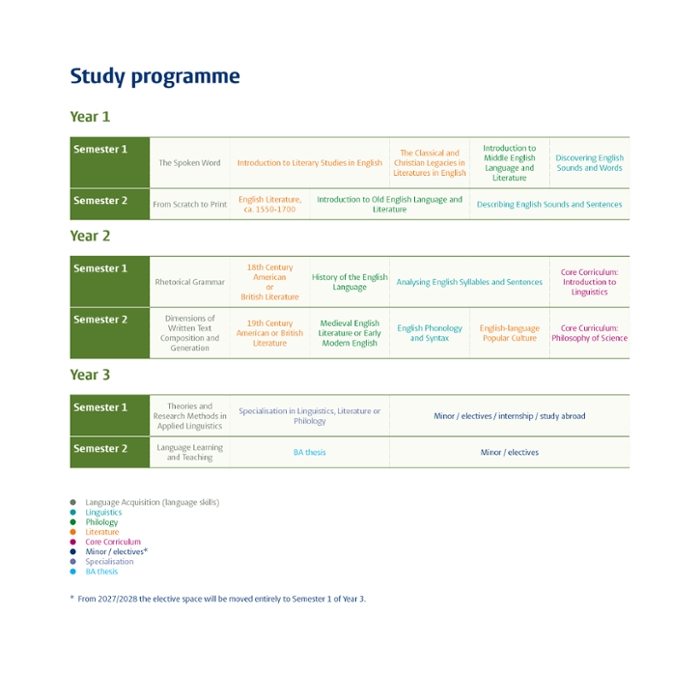
See below for an overview of the curriculum. For a detailed description of the courses, check the Prospectus. Please note that both the schedule below and the prospectus apply to the current academic year, which means that the curriculum for next year may slightly differ.
The English Language and Culture programme can be followed full-time as well as part-time. Both versions of the programme are identical in ontent; they differ only in length and workload.
More information
- Contact the study advisor.
- Join us for an information event.
- Read the Prospectus for more information.
Tailoring the programme to your interests
In the third year, you will have several options to tailor the programme to your interests. You can choose to do the programme’s electives, or put together your own tailored electives package. Leiden University offers a wide range of minor programmes, for example in Translation Studies. Dutch-speaking students can take an educational minor, which qualifies them to teach at junior level in Dutch secondary schools. Additionally, there is the option to do an internship with an international company or NGO. You can also participate in an international exchange programme at a university in an English-speaking country, such as Ireland, Canada or the US.
For excellent students, there is also the prestigious Harting programme, which offers the opportunity for students to study at the University of York or other leading British universities.