Caroline Waerzeggers
Professor
- Name
- Prof. dr. C. Waerzeggers
- Telephone
- 0715272033
- c.waerzeggers@hum.leidenuniv.nl
- ORCID iD
- 0000-0003-4186-6540
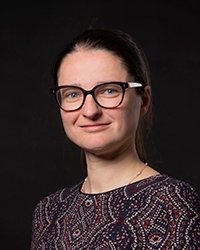
Caroline Waerzeggers is Professor of Assyriology at Leiden University. She specializes in the history of Mesopotamia in the first millennium BC, with a focus on imperial transformation under Neo-Babylonian, Persian and Seleucid rule. She is particularly interested in studying local responses to empire. Her research combines philological analysis of cuneiform texts with approaches from social, economic, literary and archival history.
More information about Caroline Waerzeggers
News
-
 Podcast: Ancient cuneiform tablets reveal their secrets
 -
 Inaugural LJSA conference 'Jews at Home: From Creation to Corona'
 -
 Cuneiform reveals shared birthplace
 -
 ‘The study of cuneiform texts is still an open field’
 -
 Caroline Waerzeggers appointed professor of Assyriology
 -
 ERC Grants for five Leiden researchers
PhD candidates


Curriculum Vitae
Caroline Waerzeggers studied Assyriology and Biblical Hebrew at the University of Ghent (Belgium), where she obtained her BA (1995), MA (1997), and PhD (2001). Following her doctoral studies, she held post-doctoral positions in Belgium and Austria, where she carried out research on the economic history of Babylonia in Michael Jursa’s START project (2003–2004) and on temple prebends in Borsippa in an FWF-project (2004–2005). She then held an assistant professorship in Assyriology at VU University Amsterdam (2006–2010) and a lectureship in Ancient Near Eastern History at University College London (2010–2012) before joining Leiden University as University Lecturer (Assistant Professor) in Assyriology (2012). She was promoted to Senior University Lecturer (Associate Professor) in 2014 and appointed full Professor of Assyriology in 2016. From 2018 to 2019, she served as Director of the Netherlands Institute of the Near East (NINO).
Research
Caroline Waerzeggers’ research focuses on the history of Mesopotamia in the first millennium BC, with particular attention to local responses to imperialism and subordination, including the social history of resistance, the impact of imperial rule on literacy and archival practice, the lived experience of displaced communities as well as of elite groups, and literary reimaginations of the past. In 2009, she was awarded an ERC Starting Grant for the research project By the Rivers of Babylon: New Perspectives on Second Temple Judaism from Cuneiform Texts (2009–2015), in which she and her team reconstructed the Babylonian environment of Judean deportees and illuminated the communities that returned to rebuild the Second Temple in Jerusalem. In 2016, she received an ERC Consolidator Grant for the project Persia and Babylonia: Creating a New Context for Understanding the Emergence of the First World Empire (2016–2021), which examined how the Persian Empire, the first world empire, maintained cohesion across an unprecedented territorial sweep from India to Libya, combining archival, social, and political analyses to situate Babylonia within imperial structures.
Among her publications feature two monographs: a study of the priesthood and cult in the temple of Babylonia’s ‘second city’ Borsippa (NINO, 2010) and a microhistorical study tracing the life of a provincial Babylonian man who, through his personal, economic, and political connections, experienced the dramatic changes brought by Persian imperial rule, revealing how global empire reshaped local society (Marduk-rēmanni: Local Networks and Imperial Politics in Achaemenid Babylonia Peeters, 2014). In 2024, together with Melanie Gross, Caroline Waerzeggers published the co-edited volume Personal Names in Cuneiform Texts from Babylonia (c. 750–100 BCE) (Cambridge University Press, 2024), which explored the multilingual and multi-ethnic character of Babylonian society, offering tools and frameworks for accessing the social history encoded in personal names in the ancient Near East. Also with Melanie Gross, she leads the digital prosopography of Babylonia project (prosobab). Her current book projects are about the role of archives and archival practices in Babylonian society (750-350 BC) and about chronography in late-period Babylonia.
She currently coordinates the Erasmus+ ICM grant project Old Languages and Writings of the Middle East, fostering staff and student exchanges with Sulaimani University in Iraqi Kurdistan to study ancient Near Eastern languages and writing systems.
Teaching
Caroline Waerzeggers teaches the following courses at the BA, MA, and Research MA levels:
-
Enslaved in Babylonia: Silences, Voices
-
Introduction to Akkadian and Cuneiform Writing
-
Priests and Temples: Babylonian Religion in Practice
-
Historians of Babylon
-
Archives and Libraries in Achaemenid Babylonia
-
De eerste wereldrijken: Egypte en het Nabije Oosten (1e millennium v.Chr tot 7e eeuw na Chr.)
-
Inleiding Akkadisch en spijkerschrift
-
Themacollege Oude Nabije Oosten-studies
-
Werkcollege Akkadisch: Het Epos van Gilgamesh
She also supervises BA, MA, and Research MA theses as well as PhD dissertations on a wide range of topics encompassing social, political, legal, linguistic, literary, and environmental aspects of Mesopotamian and Near Eastern history, covering both the Neo-Babylonian and Persian periods as well as earlier eras.
Grants and awards
2024–2027 | Erasmus+ ICM International Mobility Grant: International mobility grant for students and staff of Leiden University and Sulaimani University in the fields of Assyriology and West Asian Archaeology
2021 | Research Traineeship Grant (with L.E. Tacoma): From Wonderland to Site of Contestation: Ancient Archives in the Archival Turn (Afspraken Kwaliteitszorgen, Faculty of Humanities, Leiden University)
2021–2020 | Lorentz Workshop Subsidy (with Dominique Ngan-Tillard, Dirk Roorda, Hubert Mara, and Rients de Boer): Securing Data in Mesopotamia: New Technologies for Secured Cuneiform Texts
2019 | Research Traineeship Grant: Confusion of Tongues (Afspraken Kwaliteitszorgen, Faculty of Humanities, Leiden University)
2019 | Shaoul Fellowship: Institute for Advanced Studies, Tel Aviv University
2018 | ICT Innovation Grant: Faculty of Humanities, Leiden University
2017 | Open Access Publishing Grant: Monograph resulting from the ERC Starting Grant project (awarded by OpenAIRE)
2016 | KNAW Congress Subsidy: Conference on Middle-Babylonian society and administration (10 March 2017)
2016 | LUF Conference Subsidy: Conference on Middle-Babylonian society and administration (10 March 2017)
2016–2021 | ERC Consolidator Grant: Persia and Babylonia: Creating a New Context for Understanding the Emergence of the First World Empire
2014 | LGI Seed Funding (co-applicant): Investigating Early Complexity in Iraqi Kurdistan: Theory and Challenges (main applicant: Dr O. Nieuwenhuyse)
2009–2015 | ERC Starting Grant: By the Rivers of Babylon: New Perspectives on Second Temple Judaism from Cuneiform Texts
Professor
- Faculty of Humanities
- Leiden Institute for Area Studies
- voorzitter stichtingsbestuur
- treasurer