

Cultural Anthropology and Development Sociology
Digitalisation Research Cluster
The d12n Research Cluster provides a space for inquiry and intervention into the ongoing digit(al)isation of culture, society, and scholarship. The research cluster aims to link CADS Institute researchers to each other as well as to experts and practitioners from around the world as we combine thinking and doing in relation to digital infrastructures, technologies, and cultural forms.
We understand digitalization to be a broad process of transformation affecting practices, institutions and discourses, albeit unevenly and with varying effects. Digitalization does not just take place "out there," but affects our own work as scholars. We are particularly interested in how we can study and represent this process, but also in how social scientific knowledge can help in the development of more fair, socially just, and culturally sensitive systems. The most recent discussions within the research cluster have focused on new forms of digital scholarly publishing and on the deployment of educational technology as a form of surveillance.
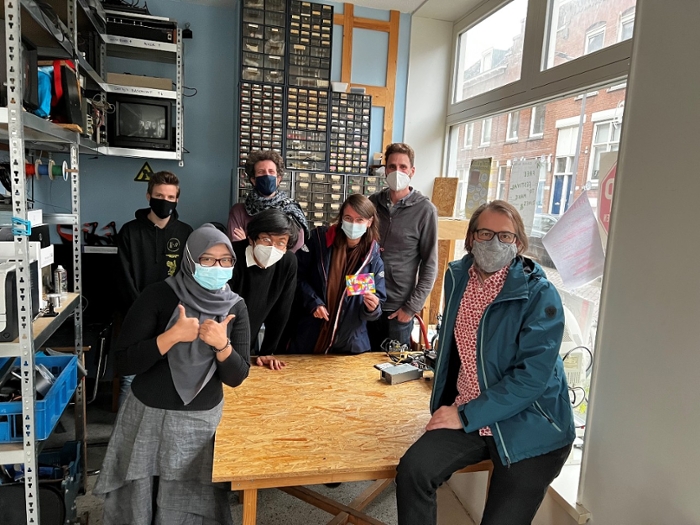
Research Cluster members
Current members


Selected publications by cluster members
- Ahlin, T. (2023). Calling Family: Digital technologies and the making of transnational care collectives. Rutgers University Press.
- Ahlin, T., & Li, F. (2019). From Field Sites to Field Events: Creating the Field with Information and Communication Technologies (ICTs). Medicine Anthropology Theory, 6(6).
- Ahlin, T., & Mann, A. (2025). Ambiguous animals, ambivalent carers and arbitrary care collectives: Re-theorizing resistance to social robots in healthcare. Social Science & Medicine, 365.
- Barendregt, B. (2017). Deep Hanging Out in the Age of the Digital; Contemporary Ways of Doing Online and Offline Ethnography. Asiascape: Digital Asia, 4(3), 307–315.
- Barendregt, B. (2021). Diverse digital worlds. In H. Geismar & H. Knox (Eds.), Digital anthropology (2nd ed., pp. 101–120). Routledge.
- Biesel, S. A. (2025). Cheia de axé (full of axé): Spirituality, resistance, and repair in Pernambuco's Afro-Brazilian traditional communities. Feminist Anthropology
- Boy, J. D., & Uitermark, J. (2017). Reassembling the city through Instagram. Transactions of the Institute of British Geographers, 42, 612–624.
- Boy, J. D., & Uitermark, J. (2024). On Display: Instagram, the self and the city. Oxford University Press.
- De Musso, F., & Grasseni, C. (2016). Picturing Intimacy. Anthrovision, 4(2).
Online since 31 December 2016, connection on 06 July 2021.
- De Musso, F. (2021). Interactive Documentaries. In C. Grasseni, B. Barendregt, E. de Maaker, F. De Musso, A. L. Littlejohn, M. Maeckelbergh, M. A. Postma, & M. R. Westmoreland (Eds.), Audiovisual and Digital Ethnography: A Practical and Theoretical Guide (pp. 143–167). Routledge.
- Elfenbein, T. W., & Hoffman, A. S. (2024). Towards meaningful institutional change: Responsive bureaucracy and the governance of anthropological ethics. Anthropology Today, 40(2).
- Fogarty-Valenzuela, B. (2020). Camera Ocupa. Current Anthropology, 61(1), 1–10.
- Fogarty-Valenzuela, B. (2024). TikTok and the Politics of Photographic Time. Current Anthropology, 65(2).
- Grasseni, C. (2021). Learning to see. In C. Grasseni, B. Barendregt, E. de Maaker, F. De Musso, A. L. Littlejohn, M. Maeckelbergh, M. A. Postma, & M. R. Westmoreland (Eds.), Audiovisual and Digital Ethnography: A Practical and Theoretical Guide (pp. 12–34). Routledge.
- Grasseni, C., & Gieser, T. (2019). Introduction: Skilled Mediations. Social Anthropology, 27(1), 6–16.
- Grasseni, C., Barendregt, B., de Maaker, E., De Musso, F., Littlejohn, A. L., Maeckelbergh, M., Postma, M. A., & Westmoreland, M. R. (Eds.). (2021). Audiovisual and Digital Ethnography: A Practical and Theoretical Guide. Routledge.
- Hölsgens, S., & Glenney, B. (2024). Skateboarding and the senses: Skills, surfaces, and spaces. Routledge.
- Ochigame, R. (2020). Informatics of the Oppressed. Logic, 11, 53–74.
- Ochigame, R., & Holston, J. (2016). Filtering Dissent: Social Media and Land Struggles in Brazil. New Left Review, 99, 85–108.
- Ochigame, R., & Ye, K. (2021). Search Atlas: Visualizing Divergent Search Results Across Geopolitical Borders. In Proceedings of the Designing Interactive Systems Conference 2021 (DIS ’21) (pp. 1970–1983). Association for Computing Machinery.
- Ochigame, R. (2025). Informática do oprimido. Editora Funilaria.
- O’Neill, K. L., & Fogarty-Valenzuela, B. (2020). Art of captivity / Arte del cautiverio. University of Toronto Press.
- Savolainen, L., Uitermark, J., & Boy, J. D. (2020). Filtering feminisms: Emergent feminist visibilities on Instagram.New Media & Society.
- Van Voorst, R., & Ahlin, T. (2024). Key points for an ethnography of AI: An approach towards crucial data. Humanities and Social Sciences Communications, 11, 337.