
Heritage against climate change: 'It can help raise awareness'
image: Wikimedia
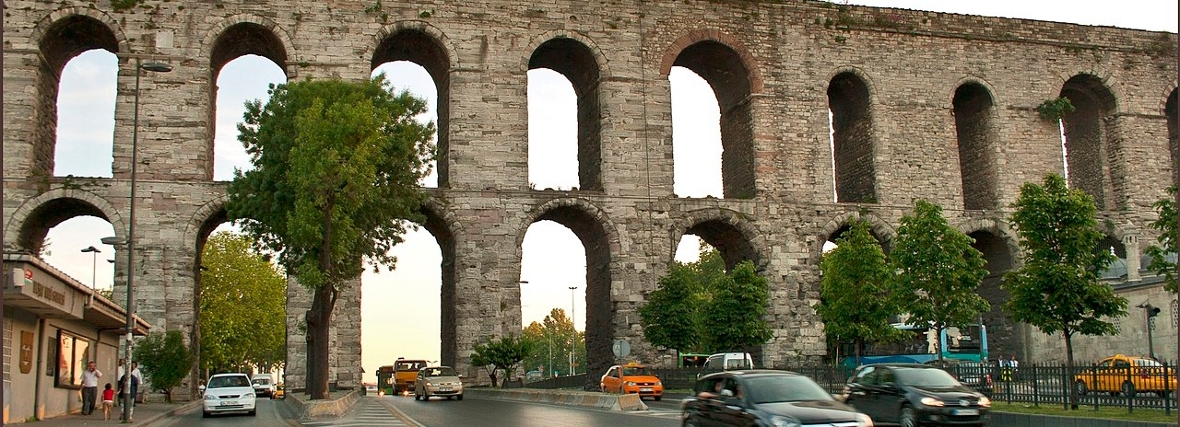
Climate change can lead to a water crisis in many large cities. Fokke Gerritsen, director of the Netherlands Institute in Turkey (NIT), argues that proper management of heritage can counteract this. He used seed money from the Impact Support Network to investigate this through the example of an aqueduct in Istanbul.
'In the urban landscape of Istanbul and the surrounding region, you have various remnants of water heritage, such as aqueducts, water supply channels, and reservoirs,' Gerritsen explains. 'The earliest ones date back to the Roman and Byzantine times, making them very suitable to demonstrate how crucial water supply has always been for urban areas and how much investment it has required.'
Sustainability and livability
This awareness is relevant because cities like Istanbul are facing a water crisis due to climate change. In a special educational programme at the NIT, participants were asked how the immediate surroundings of an ancient aqueduct could be arranged to draw attention to the importance of water in the present, past, and future.
'The aqueduct is very large and dominates the streetscape, but due to various roads around and underneath it, it is poorly accessible,' Gerritsen explains the choice of the aqueduct. 'By showing that it can also be used for temporary exhibitions, as rainwater collection, or for water festivals, we hope to make people more aware of the importance of the supply of water. At the same time, we are exploring how heritage can play a role in contemporary issues of sustainability and livability.'
Collaboration
Because the research has strong societal relevance, Gerritsen and his students collaborated with various societal partners, such as research institutes, special interest groups, and experts. This collaboration resulted in four different designs for the revaluation of the aqueduct and the restructuring of its surroundings, compiled in ‘Water Heritage for Sustainable Cities’.
For the open-access publication of this book, Gerritsen utilised seed money, a small grant to strengthen the societal impact of education and research. 'By making it available online for everyone, it’s easier to spread the new ideas and perspectives as widely as possible,' he explains. 'An earlier open access publication of ours was downloaded more than seven hundred times in just a few months. We hope this happens again. Next year, we will definitely organise an event in Istanbul, hopefully in collaboration with the municipal water authority. We can then further stimulate awareness about water and heritage.'
The Impact Support Network has limited seed money available for initiatives to strengthen the impact of education and research at the Faculty of Humanities. Funding is intended for new initiatives and cannot be used for supporting structural or ongoing activities. This can involve various types of activities, including (but not limited to) outreach, influencing policy, knowledge transfer, or societal networking.