
Georgia
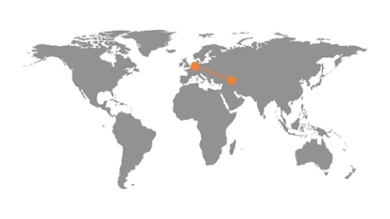
This is an Erasmus+ International Credit Mobility project of Leiden University’s Faculty of Science with Ilia State University in Georgia.
Types of mobility:
|
Project duration:
|
About the project
In this Erasmus+ ICM project, Leiden Observatory is the receiving institution in the Netherlands, the astronomy department that also hosts the European Regional Office of Astronomy for Development (E-ROAD). The ROAD offices in Leiden and in Georgia are part of a global network that collaborates on astronomy activities that contribute to the UN Sustainable Development Goals (SDGs).
For Leiden observatory, international collaborations are significant in providing students and staff with international experience and sharing knowledge. The Leiden Observatory is one of the top research institutes in the world, and it is part of the mandate and mission of the institute to use the scientific, technological, cultural, and educational aspects of astronomy to support sustainable development. This is done in collaboration with the European Astronomical Society through E-ROAD. For the E-ROAD, collaborations and exchanges with the national representatives of the South-West and Central Asian (SWCA) ROAD office in Georgia and the national representatives of the European ROAD office in Ukraine are an important strategic goal that will lead to an increase in Georgian and Ukrainian research capacity in astronomy and related technological fields, including project management, and build capacity in skills that are applicable both within and outside academia.
The E-ROAD, in return, can learn from the track record of “astronomy for development” activities from the ROAD in Georgia and Ukraine that have more experience in this field. The connection with the ROAD offices in Georgia and Ukraine is of particular interest to the European ROAD office due to their reach with neighbouring regions in Eastern Europe and collaborations with local partners on tackling development needs in the area. For Leiden University and its astronomy department that hosts the E-ROAD, engaging with developing countries and equal access are also part of the strategy to identify and reach potential future MSc and PhD students. Ilia State University, located in Tbilisi, is one of the leading research and educational institutions in Georgia, focusing on scientific advancement and transferring top-notch knowledge to facilitate societal development. Ilia State University identified the internationalisation of teaching and research as one of its strategic objectives.
More information
- Office of Astronomy for Development
- South West and Central Asia ROAD
- International Astronomical Union
Interview with coordinator Kateryna Frantseva
Project coordinator Kateryna Frantseva served as the leading force behind no less than six Erasmus+ ICM projects. In this interview, she talks about the challenges she faced, and about the substantial added value of international collaboration.
Read the full interview
Kateryna, you have been coordinating six different Erasmus+ ICM projects with many different partner universities involved. Can you tell something about your role, your main tasks and responsibilities as project coordinator?
Over the past year I coordinated ICM projects with Armenia, Colombia, Ethiopia, Georgia, Nigeria, and Ukraine. My work included managing big part of the administrative steps of each mobility, but also the academic match-making: for every incoming staff visitor together with them we identified and secured a suitable host at Leiden Observatory whose expertise aligned with their research goals. I handled planning, communication, advised on travel and accommodation, and kept close contact with both Leiden colleagues and partner universities. A large part of the role was making sure the visitors had clear goals, a productive stay, and a strong connection with the department.
Could you share a success story? What are you particularly proud of?
A good example is the Ukrainian ICM project. It was one of the most complex programmes, because we brought a full delegation of 25 Ukrainian astronomers to the Netherlands for a week-long visit. We organised a large high-level event at Leiden Observatory, visits to all astronomy and space science Dutch institutions, discussions on rebuilding Ukrainian astronomy, and a programme to help them reconnect with European networks.
In the context of the war, this visit had a special importance: it created a safe environment for focused strategic work, it strengthened institutional ties at a moment when Ukrainian universities face enormous disruption, and it helped them maintain international visibility. As a Ukrainian myself, this project also had a personal dimension, and supporting colleagues during such a difficult period carried special weight. Seeing how much the visit meant to them was one of the most meaningful outcomes of the year.
What has been particularly challenging this year?
Coordinating six partnerships at once comes with many layers. In total, I managed around 35 visitors. The Ukrainian delegation accounted for 25 people under one project, but the remaining visitors all came individually — each with a separate project, a different host, and a personalised programme.
This meant continuous communication with dozens of people, aligning their goals with available supervisors at Leiden Observatory, preparing tailored schedules, and keeping track of many parallel activities. Handling this volume of detail while ensuring that every mobility stayed meaningful and well-supported was the most demanding part of the role.
What is your vision on internationalisation in general and on the ICM programme in particular?
Internationalisation is strongest when it is based on genuine two-way collaboration. It is not only about sharing expertise with partners but also about staying open to learning from them. The Erasmus+ ICM programme is a good example of this approach. It is open to countries all over the world and creates opportunities for universities to build partnerships far beyond the usual European networks. For an institution like Leiden University, one of the leading research universities globally, ICM offers a meaningful way to both contribute knowledge and gain new perspectives from partners with different scientific environments and priorities.
Do you have any tips for future ICM coordinators?
Build strong relationships with partner contacts, communicate clearly and regularly, and stay flexible. Each mobility is different, and plans often need to shift along the way, so keeping processes simple and anticipating practical challenges early is essential. It also helps to ensure that your own department is aware of the work you are doing and actively supports it, from hosting visitors to helping integrate them into the academic environment. When coordination is grounded in trust, internal support, and clear communication, the programme runs smoothly and creates meaningful impact for everyone involved.
Astronomy for Development: Get inspired!
Due to the selected cookie settings, we cannot show this video here.
Watch the video on the original website or