
Health, Ageing and Society (MSc)
About the programme
The quality of care for our senior citizens could be improved. The master's Health, Ageing and Society focusses on biological, individual and social aspects of ageing, as well as on management of care. In this master’s you will be inspired, will learn to look with a broader view, and innovate in co-creation with the target group. Much attention is given to your personal and professional development through a variety of skills trainings, all adding up to successful opportunities in your future career!
Characteristics of the Programme
There are two options to study this master's: fulltime (1 year) or parttime (2 years).
If you choose the one-year, fulltime programme, you will need to expect five days per week on campus for face-to-face lectures and working groups. Alternatively, you can spread the course subjects and study load over a period of two years. This creates the opportunity to study the degree part-time, leaving time for a job or another study. For part-time students, every Friday, there are on-campus lectures and working groups which you are expected to attend. The other days of the week are spent studying independently and watching recordings of lectures.
The power of intensive guidance and small groups
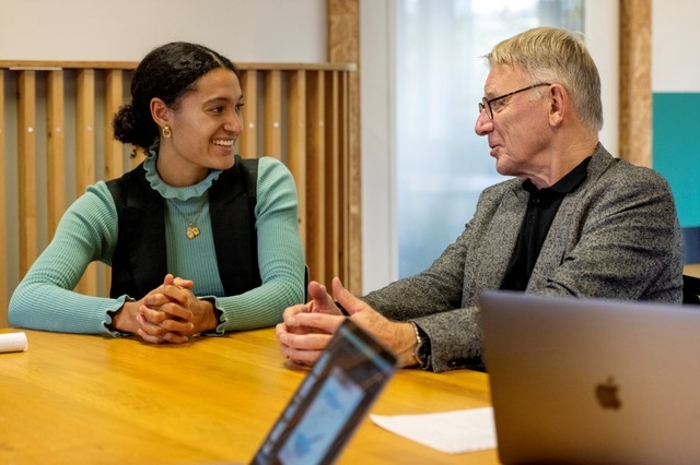
Our students appreciate the master’s programme for its personalized study methods and its small-group, international set-up. Students with various bachelor backgrounds set out to study and work in small groups to do their assignments under intensive guidance.
Fostering Creativity and innovation
We encourage you to be creative and innovative in your research and assignments. To stimulate open-mindedness, 'innovation' classes and exercises are integrated into each module. These activities are designed to challenge your thinking and inspire groundbreaking ideas.
If you would like to know more, have a look at the Course content of our programme.
A mix of cultures, languages, and people
Our students have diverse cultural and study backgrounds. You will attend interactive seminars, studying in an interdisciplinary and international environment. Together, you will find solutions to the challenges of the future, experiencing the value of this collective approach. An international approach is encouraged as a matter of course. Examples include the guest lectures by international experts, the annual study visit to the European Parliament in Brussels, and research into the healthcare systems of your international peers. Finally, many students choose to do their research internship abroad.
Interdisciplinary, intergenerational and international
Our master's programme is built on three essentialpillars: interdisciplinary, intergenerational, and international. Click on the bars below to learn more:
Interdisciplinary
Our students have diverse study and cultural backgrounds. Also some students are already working professionals. Together, you will discuss, perform research and look for solutions to the challenges of the future, experiencing the value of this collective approach.
- Students and professionals enter from different health related studies. There is a list of free admissable bachelor degrees, but we are certainly also open to degrees that are not quite health related; diverse insights enrich our imaginations! Entry requirements can be found in the the Application and Admission section of our website.
- The courses are given on topics and perspectives on the unprecedented growth in the number of older people in our western societies. Viewed from biological, social and management aspects.
- Our Master’s seeks coordinators and lecturers from the medical, social and public administration faculties.
Intergenerational
The Health, Ageing and Society master’s programme offers a valuable expansion of knowledge and insight for students as well as experienced professionals from the broad field of healthcare. There is a wide mix of ages and levels of experience, offering the added value of a fresh approach combined with dedicated experience in the field.
In addition, older people are involved in the curriculum in various ways; as members of the advisory council, as participants in the lectures, and taking part in innovation projects together with the students in for instance co-creation sessions.
International
When it comes to elderly care, our country leads the way. Our master’s programme offers international students a unique opportunity to learn more about the Dutch views, systems, and challenges, and to compare them with healthcare systems in other countries. Do the systems match up or are they totally different? Finding the answer to this question will lead to surprising new questions, remarkable perspectives, new insights and solutions.
Below are some more international aspects of the master's programme:
- The language of instruction for the Master’s is English.
- International study material is used.
- The Master’s is very suitable for international students who would like to learn about the Dutch healthcare system and want to study in The Netherlands for a year, or two years if you want to follow the parttime programme.
- Lectures by international experts.
- Study trip to Brussels and Ghent.
- Dutch students are encouraged to seek internships abroad.
Angelika Gilli
Student HAS

"I wanted to broaden my horizon in the field of ageing. Since this Master offers very different points of views it is actually more than my expectations were."
Eva Edam
Student

"Before beginning my clinical rotations, I wanted to have a useful gapyear. This one-year master’s programme really stood out to me because of it’s broad curriculum. Besides that, I wanted to learn more about all the aspects of ageing."
Esther Werkman
Student

"A highlight for me is that older individuals are involved in the study programme. They sometimes give feedback for assignments, or we interview them to learn more about their experience. I think this is very valuable."