
Capitals Can Be Planned, Cities Must Be Lived
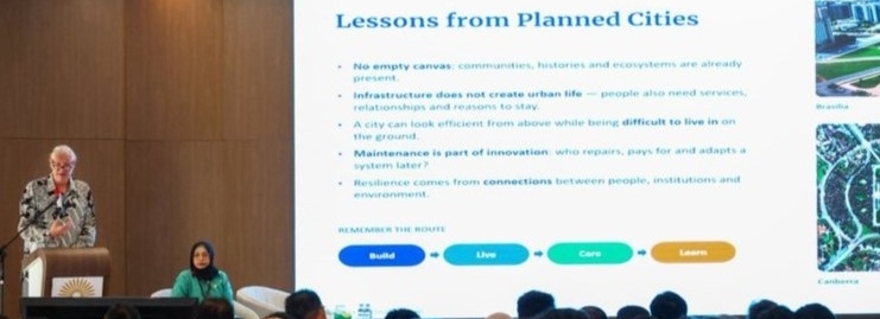
‘A capital may begin with a master plan, but the city only starts when people start living it,’ Bart Barendregt, Dean at Social and Behavioural Sciences and Professor Anthropology of Digital Diversity, opened his lecture at Nusantara.
His lecture was part of Nusantara Urban Dialogue, took place in Nusantara, 21 August 2026. This dialogue served as a platform for strategic discussions regarding sustainable infrastructure planning and development in Indonesia's new capital city. Titled Capitals Can Be Planned, Cities Must Be Lived: Learning for Sustainability and Resilience in a More-than-Human Nusantara, his lecture examined the elements required to build a city where people can work, care for one another, connect, learn, and feel a sense of belonging.
As a forest city, Nusantara should not treat the forest simply as a green background. It is a living system, and human life depends on it. It is fundamental to consider the surrounding environment when planning the city. Bart underlined the importance of putting some local wisdoms into dialogue with recent scientific insights. ‘There have been communities here (around Nusantara) for centuries that have a different view of the forest. They have lived with the forest, using it while also taking care of it. Scientific research, local wisdom, and cultural knowledge can come together to reconcile.’

A city cannot truly thrive without healthy communities, both physically and mentally. Being relocated to Nusantara may be exciting, but it may be very stressful. Sometimes people may go through a sense of isolation. Communities should have access to medical care, nutritious and affordable food, rest, and activities that can help to develop a healthy mindset. Nusantara Capital City Authority has planned to move 1,700 to 4,100 state civil servants to Nusantara by 2029.
Bart Barendregt concluded that the social scientists can help study how such a city may work in practice, ot only when a crisis has already happened or a disruption is about to begin, but before that happens. Planners, designers, and architects can engage in dialogue with psychologists, anthropologists, and sociologists. Together, they may find solutions that otherwise might seem to work at first but may not work in the long run. 'Keep in mind, no city is future-proof. Nusantara can, however, become future-ready by listening, adapting, and learning at the same time. And ultimately, it must be lived.'