Rosalba Icaza Garza
Professor
- Name
- Prof. drs. R.A. Icaza Garza
- Telephone
- 071 5272727
- r.icaza@fsw.leidenuniv.nl
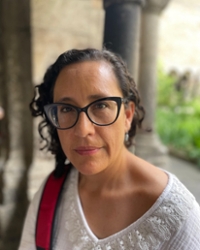
Rosalba Icaza is Full Professor of International Relations, and Scientific Director of the Institute of Political Science at Leiden University. She currently serves as member of the Advisory Academic Board of the Netherlands Institute for Advanced Study (NIAS) and the International Advisory Board of the NWO-funded project Race and Equality in Dutch Academia.
More information about Rosalba Icaza Garza
I am a decolonial feminist scholar-activist, mentor, and teacher with over 20 years of experience across Latin America, the Caribbean, Europe, and Australia. Prior to Leiden, I worked for 17 years at the Institute of Social Studies, Erasmus University Rotterdam where I was Professor of Global Politics, Feminisms and Decoloniality and Vice-Dean of Research.
My work focuses on the geopolitics of knowledge production, eco-epistemic justice, and the decolonization of higher education. In essence, I ask: What counts as knowledge? Whose knowledge is rendered nonexistent, and why? And what can universities and societies do to overcome the geopolitical, geohistorical, eco-epistemic inequalities in knowledge production? In addressing this questions, I intersect the fields of global politics, feminisms, and decoloniality.
I have conducted and supervised research across four continents and regularly provide expert advice to academic, cultural, and policy institutions in the Netherlands and beyond. In 2016, I conducted research on the governance of diversity and inclusion in higher education as part of the Diversity Commission of the University of Amsterdam chaired by Emerita Professor Gloria Wekker. I have also provided expert advice to the Advisory Council on International Affairs (AIV) at the Netherlands Ministry of Foreign Affairs, the Nederland Nationaal Archief, the Prince Claus Fund for Culture and Development, and the Nederlandse Organisatie voor Wetenschappelijk Onderzoek (NWO).
Presently, I collaborate with the Autonomous Cooperative Publishing House RETOS (Chiapas, Mexico), the Indigenous community Suumil Mookt'an (Yucatán, Mexico), co-convene the transnational learning collective Nurturing Each Other and participate in the Decolonial Semillero conversation group.
I have examined 18 PhDs in 10 countries and have also personally supervised 10 completed PhDs students from 5 different countries:
- Dr Frattina – Oxford;
- Dr Dupuis – EUR;
- Dr Bejeno – EUR;
- Dr Beckley – Univ Malta;
- Dr Gabor – EUR;
- Dr Cadaval – EUR;
- Dr Music – Univ Barcelona;
- Dr Trejo – EUR; Dr Soukotta – EUR;
- Dr Sheik – EUR.
I currently supervise 8 PhD students:
- Umbreen Salim – EUR;
- Ana Barbosa – EUR;
- Lisa Marlene Gronemeir – EUR;
- Jonny Moniz – EUR;
- Laura Barbalite – Leiden;
- Josephine Zwam – EUR;
- Roland Alvarez – EUR;
- Watfa Najidi – EUR.
I have also mentored 4 postdocs from 4 different countries: Dr Alejo, Dr Solera, Dr Martins, Dr Midtvage Diallo, and supervised around 160 MA Dissertations.
My research lies at the intersection of global politics, feminisms, and decoloniality over the following intersecting themes:
Global Politics and Epistemic Justice
How can one revisit the modern/colonial character of notions such as region, regionalism, social resistance, and global justice without reproducing epistemic violence? My way of working this question has been through the identification of decolonial trajectories in knowledges and cosmovisions that have been actively produced as backward or ‘subaltern’ by hegemonic forms of understanding of 'the international'.
Plural feminisms for plural liberations – How modes of knowing and being are produced through experiences of epistemic vulnerability and fragility when encountering and hosting radical difference? I have explore an epistemic dimension of collective action across borders and epistemologies of affect and the corporeal in social struggles. I am deeply interested in intercultural dialogues among different strands of feminism and in particular ideas of coalitional politics, plural and communal selves as developed by declonial feminist and popular educator Maria Lugones.
Collaborative/Co-creative Research Methodologies
How can research foregrounds active engagement with and accessibility to what has been collectively learned? To answer this question, I have developed collaborative research methodologies characterized by its engaged and rigorous non-extractive approach to knowledge cultivation (Robbie Shilliam’s term) through mutual learning across differences and research outputs for different audiences, including academia, teachers and students, local policymakers, and religious/faith based communties.
Thinking academia in the promotion of autonomy
Can modern/colonial academia contribute to sustaining forms of epistemic dissent that promote social and ecological justice and autonomy? And if so, how? In exploring these questions, I have been involved in different collaborative initiatives, including the Transnational Network Other Knowledges (RETOS) and its autonomous co-operative publishing house and the Maya Indigenous cooperative and familiar initiative Suumil Mooktaan in Sinanche, Yucatan, Mexico.
Learning as liberation/liberation of learning
What is learning for? I am interested in the application of anti-oppressive and decolonial pedagogies in my teaching articulated with Rolando Vazquez as pedagogies of positionality, pedagogies of relationality, and pedagogies of transition. In teaching about the politics of decolonial investigations and decolonizing research practices, I seek to encourage relational accountability and mutual (un)learning. My pedagogical practices are inspired by Third-world, Chicana, Black, and decolonial feminist theories and epistemologies. I have collaborated with the Going Glocal initiative - co-financed by the Dutch Ministry of Foreign Affairs as a pioneering effort in education and research on global citizenship in the Netherlands. I also have taught in the yearly Decolonial Summer School "Maria Lugones" co-organized with the UCR/UU and the Van Abbe Museum in Middelburg and Eindhoven, and since 2025 I teach in the Roskilde University PhD School “Coloniality of Knowledge”.
Collaborations, Coalitions, Relationships
As someone who constantly seeks long-lasting collaborations in the Netherlands and abroad with academic, policy, and activist networks concerned with global eco-epistemic justice and plurality, I value the practice of critical self-reflexivity as a basis to respond to and be with others effectively but caringly.
Teacher, Mentor, Woman of Color
As a teacher, and mentor in both undergraduate and postgraduate education in seven different countries, I have learned the importance of deep listening, connection, and relation for sustaining long-lasting collaborative work. As a woman of color, I understand my role in academia as an opportunity to honor those who precede me and mentor those who come after me.
Professor
- Faculty of Social and Behavioural Sciences
- Policital Science
- Member of the Assembly
- Co-Editor