
Research project
Comparative Psychology
What is emotion in human and nonhuman animals? How do emotions get to expression and how do they impact on our interactions, our decisions to trust, distrust or cooperate? Why do we mimic and synchronise affective processes?
- Duration
- 2026
- Contact
- Mariska Kret
- Funding
-
 NWO VIDI
-
 ERC Starting
-
 Mercator Sapiens Stimulus
-
 KNAW Hendrik Muller
Scientific background
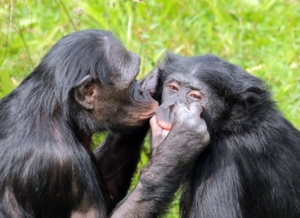
What is emotion in humans and nonhuman animals? How do emotions unfold into expression, and how do they shape social interactions, including decisions to trust, distrust, or cooperate? In her research programme, Mariska Kret addresses these questions through a comparative, functional approach that integrates humans, great apes, and dogs. Guided by Tinbergen’s four questions—mechanism, ontogeny, function, and phylogeny—this work conceptualises emotion as an evolved, dynamic process that coordinates physiology, attention, expression, and social behaviour across species.
Research Objectives
A central aim is to understand how genuine, spontaneous emotional expressions—rather than posed or acted displays—emerge and operate in real-world contexts. Emotions are studied in all their complexity using a multimethod approach that combines functional magnetic resonance imaging (fMRI), psychophysiology (e.g., heart rate, skin conductance, hormonal measures), behavioural observations, and eye-tracking. This integrative framework allows investigation of both underlying neural and physiological mechanisms and their observable social consequences. By coupling questions about what emotion is with what emotion is for, the research directly links affective processes to adaptive functions such as social decision-making, affiliation, conflict regulation, and cooperation.
Study Design and Methods
Comparative studies with humans, great apes, and dogs illuminate both shared evolutionary roots and species-specific adaptations. Collaborations with zoos enable in-depth investigation of attentional and motivational processes in nonhuman animals. For example, eye-tracking paradigms are used to examine how apes and dogs allocate attention to emotional cues, while touchscreen-based tasks—including preference paradigms—assess socio-emotional biases and decision tendencies. In parallel, zoo visitors perform the same tasks as the apes, creating a unique cross-species comparison and fostering public engagement around animal cognition and emotion. These efforts generate ecologically valid insights while stimulating dialogue about the continuities and differences between human and nonhuman minds.
Psychology Lab on wheels
To capture emotions “in the wild,” this research extends beyond the laboratory into festivals, schools, companies, and other naturalistic settings. Using a mobile “psychology lab on wheels,” spontaneous affective interactions are measured during real-life events, such as blind date experiments. These field studies allow assessment of mimicry, interpersonal synchronization, and physiological coupling as they unfold in authentic social encounters. Such designs provide critical insight into why individuals automatically mimic and synchronise affective expressions, and how these processes facilitate bonding, empathy, and trust—or, conversely, signal threat and promote avoidance.
Shaping of Emotion
Cross-cultural comparisons in Japan, Uganda, and the United Kingdom further probe the universality and cultural modulation of emotional processes. By examining similarities and differences in expression, attention, mimicry, and social decisions across diverse populations, this work addresses fundamental questions about the phylogenetic and cultural shaping of emotion. Together, these studies position emotion as a biologically grounded yet context-sensitive system that regulates social life. By integrating neuroscience, physiology, comparative cognition, and real-world observation, this research advances a comprehensive understanding of what emotions are, how they become expressed, and why they matter for cooperation, trust, and social cohesion across species.
Open Science
Research data can be accessed through:
- Dataverse
- CoPAN GitHub
Strategic Priorities
Open Science, Interdisciplinary