
Research project
ADHD&me: improving self-esteem in young adults with ADHD
ADHD&me is a new cognitive-behavioural therapeutic intervention for young adults (16–25 years old) with ADHD, specifically aimed at improving self-esteem. In this study, we are conducting a Randomized Controlled Trial (RCT) to examine whether this intervention improves self-esteem and whether related symptoms, such as anxiety and depression, decrease.
- Duration
- 2024 - 2028
- Contact
- Bianca Boyer
- Funding
- Startersgrant, LUF
ADHD across development: changing challenges, changing care
ADHD is a neurobiological developmental disorder that often emerges in childhood. However, the challenges faced by individuals with ADHD change over the years, and the treatment changes with them. In childhood, behavioural problems are often central, and care typically focuses on parent training. Parents learn how to provide structure and how to support their child in behaviour and attention. In adolescence, when young people transition to secondary school and become more independent, problems with executive functions more frequently come to the forefront. Treatment during this phase usually consists of training in planning skills and/or medication. In young adulthood, the world grows larger: study choices, education, moving out, work, independence, finances, and increasingly complex social relationships bring new responsibilities and expectations. In this phase, a new central question arises: How do I relate to my ADHD? And what place does it have in my life?
Despite a growing need, there is currently no treatment specifically aimed at coping with ADHD during this stage of life. One important theme also remains largely underexposed in clinical practice: self-esteem.
The importance of self-esteem
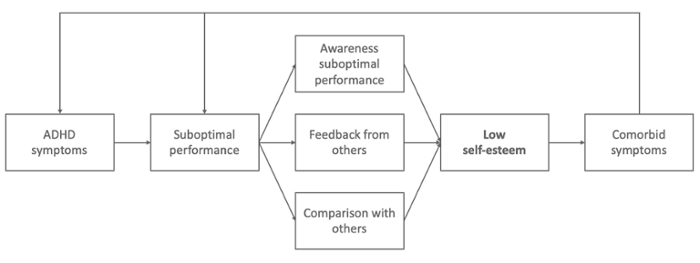
Many young adults with ADHD have a history of stumbling moments: problems at school, difficulties with organisation, conflicts at home, social misunderstandings, or negative feedback from others. In young adulthood, responsibilities and expectations increase even further, which can make existing challenges even more visible. This can put additional pressure on self-esteem and contribute to low self-esteem. Low self-esteem, in turn, increases the risk of anxiety and depressive symptoms and can exacerbate ADHD symptoms. As a result, young adults may find themselves in a negative vicious cycle.
With ADHD&me, we therefore focus specifically on self-esteem. The newly developed intervention consists of seven individual sessions and helps participants to better recognise their strengths, qualities, and positive traits, to develop a more realistic self-image, and to discover what does and does not work for them in daily life.
Study design
For this study, we will recruit young adults with ADHD between the ages of 16 and 25 in collaboration with various participating Dutch mental health institutions (GGZ), psychology practices, and educational institutions.
For more information about the ADHD&me project you can contact us at adhd@fsw.leidenuniv.nl