
Dissertation
Evolution of Au(111) Electrode Surface in Different Electrolytes and Conditions Studied with a Home-made EC-STM
In this study, we investigated the electrochemical behavior and surface evolution of Au(111) electrode under different conditions and electrochemical techniques, using a homemade electrochemical scanning tunneling microscope (EC-STM), revealing the intricate interplay between surface roughening, atom mobility, and impurity effects.
- Author
- S. Behjati
- Date
- 28 January 2026
- Links
- Thesis in Leiden Repository
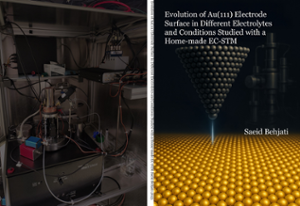
Initially, the working principle of the EC-STM is explained, and the mechanical and electrical specifications of the designed modules for this instrument are discussed. This technical information can be eye-catching for many individuals with an engineering background, but having a good understanding of the design can make running the experiments easier for other researchers (i.e., electrochemists) and reveal the capability of the instruments for more complicated experiments.In the first investigation conducted in 0.1 M sulfuric acid, we elucidated Au(111) roughening, demonstrating that it initiates with 2D island formation followed by 3D growth. Delays in the double-layer potential region led to larger 2D islands at lower ORC numbers and reduced roughness amplitude for the entire cycle numbers, driven by high gold atom mobility. Though oxidation-reduction charges were inversely correlated with roughness, suggesting terrace sites contribute more to charge density than roughened areas.In the second study, we explored the impact of chloride ions in 0.1 M sulfuric acid containing traces of HCl concentrations (1–50 μM) over 200 oxidation-reduction cycles (ORCs). High chloride levels (50 μM) induced rapid Au dissolution and high atom mobility, suppressing vacancy island capturing in the STM images and surface roughening, with minimal CV changes, while lower concentrations (10 μM) allowed slower dissolution and detectable vacancy islands, introducing new CV peaks caused by the new defect sites. At the lowest concentration (1 μM), inhomogeneous chloride adsorption changed the roughening process over the ORCs.Finally, the third investigation in HClO4 solutions highlighted anisotropic surface evolution by altering the electrochemical double-layer structure and reaction dynamics likely due to the trace amount of impurities in the solution. These impurity effects highlight the complexity of the prediction of the surface electrode response of Au(111) at different spots. The results of this work can offer some valuable insights for a better understanding of gold-based electrochemical systems and raise more fundamental questions for future research.