
Research facilities
Bioinformatics and Genomics
- Application
- The Bioinformatics and Genomics Core provides bioinformatics advice and genotyping services. The researchers that lead and work for this facilities are experts in their fields and are available for consultation regarding experimental design and interpretation of results.
- Contact
- Christiaan Henkel

Our genomics research focuses on genome function and evolution, as well as on application and development of the novel genomics technologies necessary to study these subjects (e.g. de novo assembly of large genomes based on nanopore sequencing). We work both independently as well as in collaboration with other research groups within the Institute of Biology.
The Bioinformatics and genomics core has updated state-of-the-art instruments that can be applied high throughput sequencing and SNP genotyping.
Available instrumentation
PoreLab
In collaboration with the Generade Centre of Expertise in Genomics and University of Applied Science Leiden we operate a small lab (‘wet’ and ‘dry’) dedicated to exploring the possibilities of DNA sequencing using the Oxford Nanopore MinION. Current projects focus on genome sequencing and metagenomics applications.

SNP genotyping line
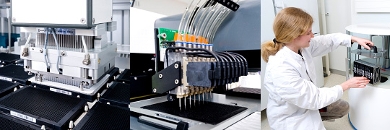
Jointly with the LGTC of the LUMC the Institute Biology Leiden has a high throughput SNP genotyping line. The detection is based on allele-specific labeled primers (KASP technology) in single wells and the equipment allows high throughput (>100.000 datapoints per day) genotyping. SNP primer design is performed with the dedicated Kraken software. Kraken is a multipurpose LIMS software that tracks all samples and assays while being processed reducing errors to a minimum.
The SNP genotyping line is very flexible in the number of SNPs (1-1000) and can handle between 96 and 10.000 samples.
PhD Course Transcriptomics
Every year, we organize a PhD course transcriptomics, where you will learn the basics of RNA-seq analysis, including:
Topics
- Experimental design
- Sequencing options
- Quantification and normalization
- Differential expression analysis