

Knowing the ocean means living with uncertainty
Social sciences connect image: Suédy Mauricio
As sea levels rise and climate change speeds up, knowledge about the ocean becomes increasingly more important. But how is this knowledge being created and how can we use it best to prepare for the future? To answers these questions, Jackie Ashkin studies the day-to-day work of ocean scientists from up close.
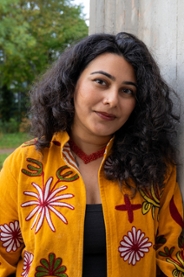
Jackie Ashkin is a PhD candidate at the Centre for Science and Technology Studies (CWTS) with a background in anthropology. She studies how the ocean is being researched and how our knowledge about it is created, shared, and used, with a special focus on computer models of the ocean. Her PhD project is part of Fluid Knowledge, a research project funded by the European Commission and led by Sarah de Rijcke that ran from 2019 until 2025. The project aimed to better understand how the field of ocean science has developed over time, what the conditions of the daily work of ocean scientists look like, and how this field is affected by science policy.
Rising sea levels
The vast ocean might feel far away, but global events such as the rise of sea levels can have very local effects. For example, ice melting in Antarctica can influence sea levels in Europe due to gravitational effects. In the Netherlands, where between one-quarter and one-third of the country lies below sea level, this really matters. The question is, how do you study something as huge as the ocean?
To explore these places that humans cannot access easily, ocean scientists rely heavily on computational models. But these models are not neutral. In her research, Jackie is trying to understand the different factors that go into creating the models, such as who pays for them, who has time to work on them, which data they are built on, and who has the necessary infrastructure to use them.
When sensors get buried in the mud
Ocean science works differently from many other scientific fields: instead of building step by step on well-established knowledge, it often starts from a place of not knowing much at all. ‘In a lot of science, it’s like: here’s what we know, and here’s a small gap’, Jackie explains, ‘while ocean research often begins with the opposite: here is everything we don’t know, and here’s the small picture we have managed to put together.’ One reason is the difficulty of collecting data in the ocean–or in coastal areas, which Jackie focuses on.
‘Doing coastal research is hard but it’s much harder if you don’t have the money to send someone out every two weeks to clean a sensor.’
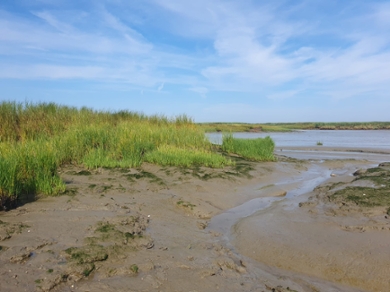
For example, sensors placed on the Dutch coast quickly get covered in mud and need to regularly be cleaned. This means that research conditions matter a lot: ‘Doing coastal research is hard but it’s much harder if you don’t have the money to send someone out every two weeks to clean a sensor’, Jackie says. ‘And that is if the weather is good.’ As a result, what gets measured and the data that is eventually used in computer models is not only a scientific issue, but is shaped by the materiality of the coastline, as well as how research is organized and paid for.
Looking behind the numbers
To immerse herself in ocean research, Jackie does not only read documents and interview researchers. She completely becomes part of the ocean researchers’ day-to-day life, attending team meetings and conferences and joining them on field trips. Sometimes, this also means just sitting next to a researcher while they are creating a computer model–which can be funny at times: ‘They find it quite comical. You're sitting there, you're like, OK, why did you do that? And they're like, this is just how code works. This is how I code.’
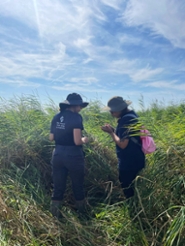
Jackie uses her observations to understand better the many different factors that are behind ocean scientists’ work. This includes their working conditions, how they develop particular models, the data that feeds into these models, and how they present their findings to non-scientific audiences. The last point is not trivial: ocean models come with complex premises and uncertainties that can influence how we think about and plan ocean futures. To communicate this adequately, Jackie’s perspective helps to highlight issues that may be obvious to researchers from the field, but not a broader audience.
Living with what we don’t know
Even showing a map with ocean data is not that straightforward: ‘When you see a map showing data of the whole ocean, that doesn't mean that the knowledge that we have is evenly distributed. How do you represent that visually? That is the big question. How can we make it so that you can really see what's going on?’

Jackie mentions an experience from an ocean science conference where sea surface temperature was presented on a world map. Looking at the map, one might think that there is as much information available for the Southern Ocean as for the North Atlantic. What was not apparent is that the results shown for the Southern Ocean were based on only a small number of observations, while in the North Atlantic, there was much more information, thanks to more sensors in the water. This might be obvious to scientists working with this kind of data, but these maps are also used for example by policy makers to plan for the future. They might wrongly assume that we know as much about the Southern Ocean as we know about the North Atlantic.
Geography matters
In her research, Jackie would even go a step further and ask why there are more sensors out in the waters of the North Atlantic. Again, the answer might not be immediately obvious. More sensors require more resources, which are easier to find if there is strong interest in a region, such as from fisheries or many neighbouring countries sharing a coastline. Additionally, someone has to go and place the sensors, and the Southern Ocean is remote and far away from countries with the largest ocean-going research fleets. This shows that geography and the organization of science matter a lot to really understand what we are looking at and what we cannot know.
Learning to deal with uncertainty
Jackie’s research highlights some of these blind spots and shows the deep connections between a challenging research object, the infrastructures available to collect and analyse data, and the institutional context of ocean science. With these insights, we can ask better questions about the limits of what we know about the ocean, what contributes to those limits, and how they can be communicated responsibly.
‘We like numbers because they feel manageable. But maybe we also need more room to acknowledge how much we don’t know.’
It also means learning to deal with uncertainty, as Jackie explains. Society tends to lean on numbers, predictions, and precise forecasts to manage risk. But the case of ocean science shows that certainty cannot always be achieved. ‘There’s something about getting comfortable with uncertainty’, Jackie says. ‘We like numbers because they feel manageable. But maybe we also need more room to acknowledge how much we don’t know.’
About Social Sciences Connect
Each month, we publish an article showcasing how social science research and education contribute to solving societal challenges. Researchers, lecturers, students, and societal partners work together to make knowledge accessible and to make a difference. Through open science and engaged education, we strengthen the connection between the university and society. In this way, we build a future together in which science and society go hand in hand.