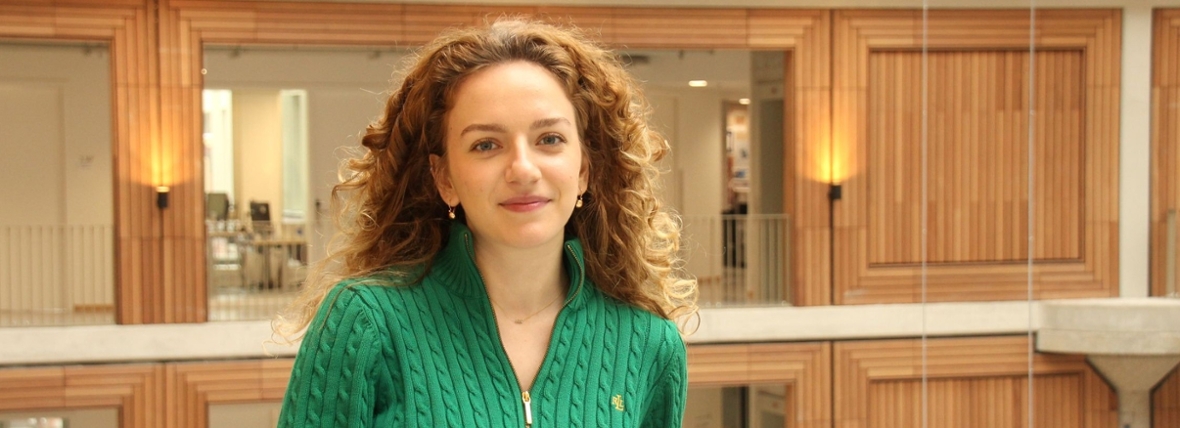
Evanthia's minor now allows her to combine her favourite subjects
Minor image: Nehir Aksel
From a bachelor's degree in English Language and Culture to a master's degree in International Relations: a minor made it possible for Evanthia Andreadaki. 'For me, this is the perfect combination.'
At the end of the coronavirus pandemic, Evanthia began to feel restless: did she really want to study in Greece, as had been the plan until then, or would she rather seek adventure abroad? ‘Say what you will about the pandemic, but we had plenty of time to think about what we really wanted,’ she recalls.
In her case, that turned out to be studying in Leiden. ‘My parents always insisted that I had to have a plan if I went abroad,’ she says. ‘That’s why I looked not only at the bachelor’s programmes, but also at the minors. Leiden turned out to be the only university where you could do a minor in European Union Studies at the Humanities Faculty. I already knew that I wanted to go into international relations, politics or diplomacy, but I also really love literature and writing. So the combination of this minor with a bachelor’s in English Language and Culture was perfect for me.’
Gaining new knowledge
When planning your future remotely, there is always the risk that reality will disappoint. That was not the case for Evanthia. ‘I was quite nervous when I started my minor,’ she says. ‘I knew virtually nothing about political science and suddenly I was attending lectures on it. Fortunately, in the end, I never felt that I should have had more prior knowledge.’
However, the minor does involve a lot of hard work. ‘Because it's also a pre-master's programme, it lasts two semesters instead of one,’ Evanthia explains. ‘I never studied as hard in my bachelor's programme as I did that year. Fortunately, I met some nice friends. I would advise anyone starting the programme to make sure you have people from your group around you. We really helped each other through it.’
Enjoying it
Evanthia has now enrolled in the master's programme in European Union Studies. ‘Thanks to the minor, I now feel much more comfortable with different subjects,’ she says. ‘Last year, with political science, all I could think was: I know nothing about the historical relationship between France and Germany. Now I can really absorb the material.’ Her bachelor's degree in English is also coming in handy. ‘In a language programme, you learn to write and reason very well, which almost creates an extra layer of critical thinking,’ she says. ‘I can really use that now.’
In her thesis, for example. ‘I'm going to map out how Greek media view migration and European policy,’ she explains. ‘To do that, I'm using methods I learned in English, but applying them to a topic from European Union Studies.’