

From walking sticks to guide dogs: Krista Milne charts the lives of medieval people with disabilities
VIDI-beurs image: Nehir Aksel
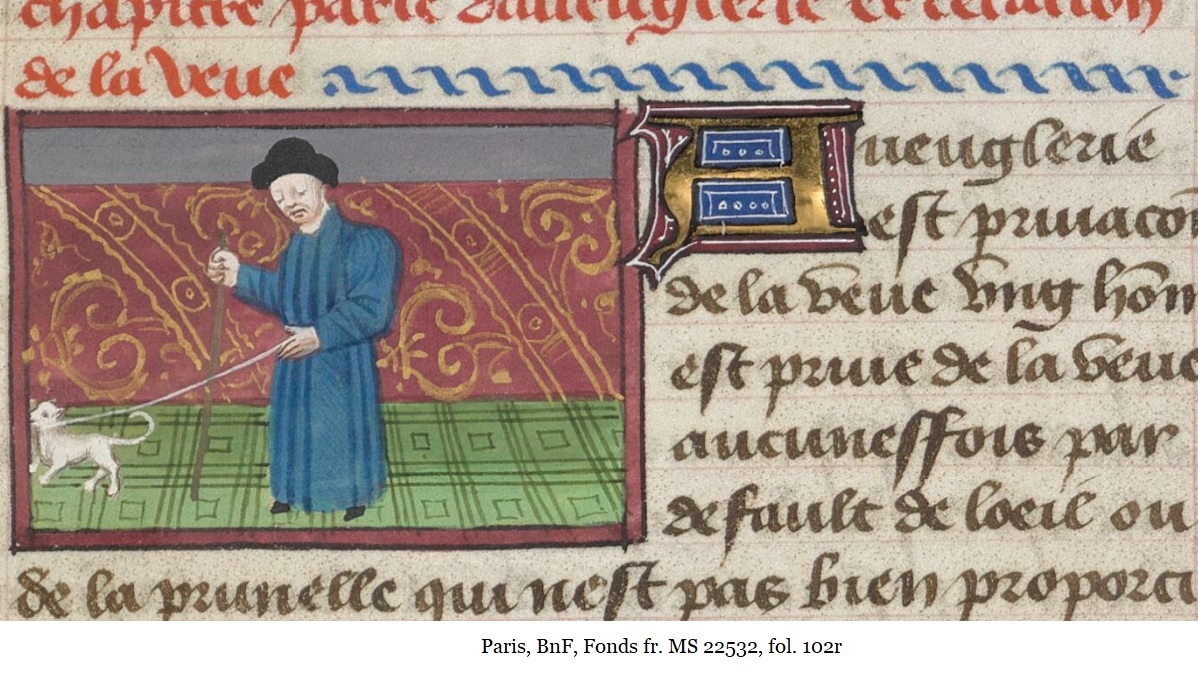
What was life like for people with disabilities in the Middle Ages? University lecturer Krista Milne delved into medieval manuscripts and found more than thirty images of assistance dogs of all shapes and sizes. Now, a Vidi grant is enabling her to expand her research to include the question of what other aids were available to medieval people.
Both academic and popular publications often claim that assistance dogs are a modern invention. With an NWO XS grant, Milne proved the opposite last year. ‘I already knew some scholars had found individual representations of guide dogs, but nobody had looked at them on a larger scale and put them into dialogue with each other.
All shapes and sizes
That is exactly what Milne did. ‘I didn’t expect to find more than ten artistic representations, but I actually found about thirty’, she says. ‘‘This allowed me to delve deeper into the subject matter and discover, for example, that the number of guide dogs depicted increased in the twelfth and thirteenth centuries, although this may also be due to the fact that the number of illustrated manuscripts also increased during that period.’
What is certain is that medieval assistance dogs come in all shapes and sizes. Milne: ‘There was a scholar who argued that only small dogs were used as guide dogs in the mediaeval period, unlike today, with our German shepherds and Labradors, but I found a very wide variety of dogs.’
-
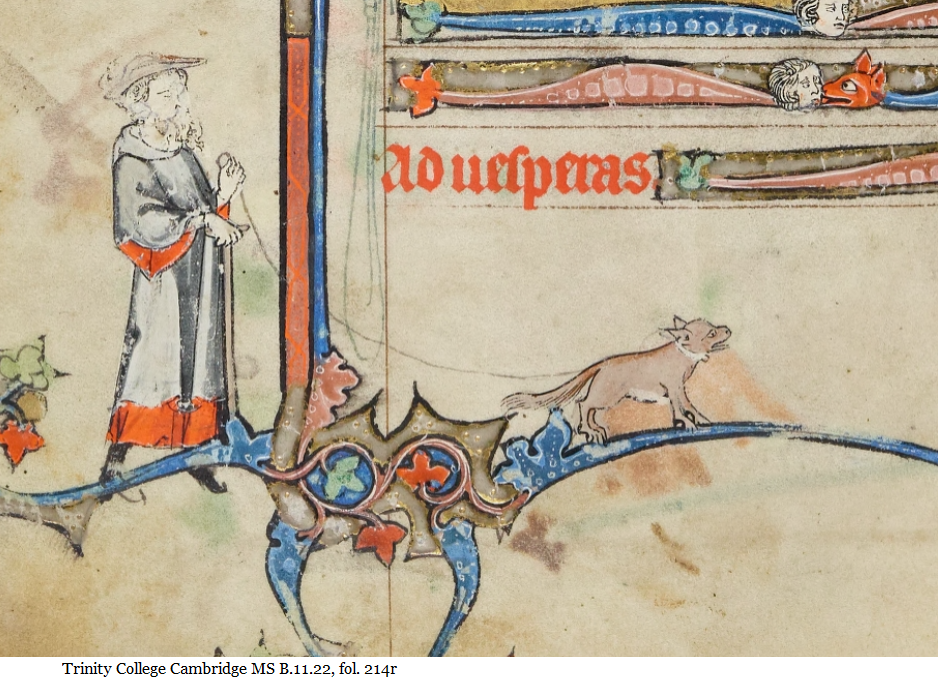
Trinity College Library Cambridge -
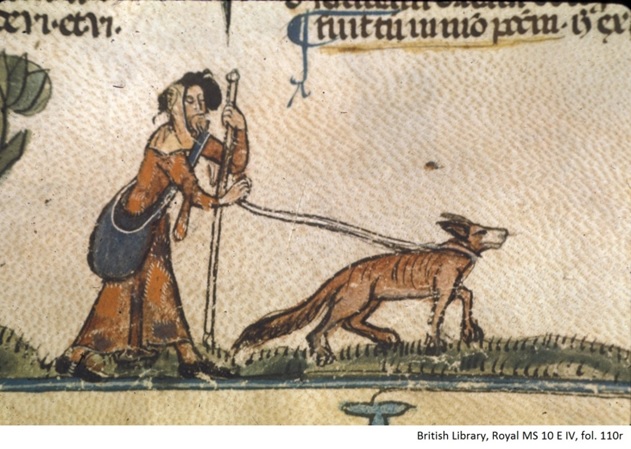
British Library -
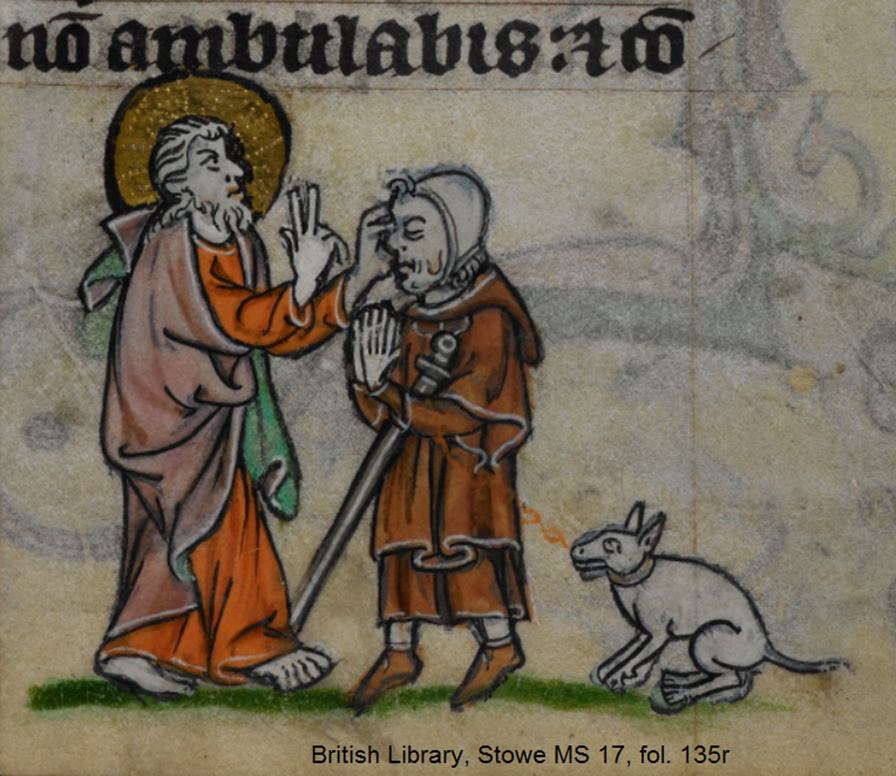
British Library -
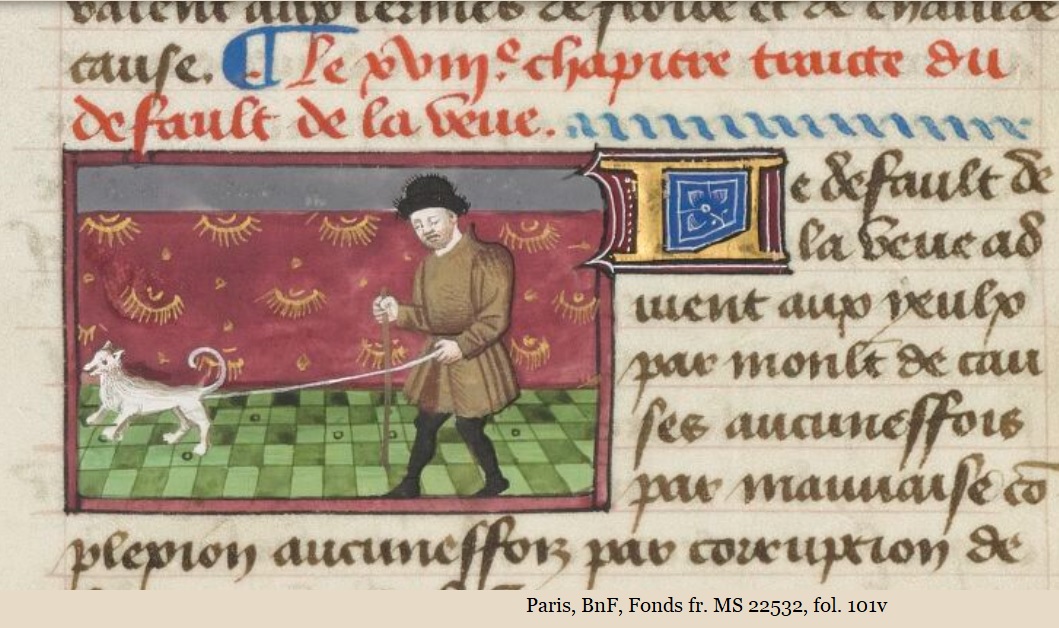
BnF ou Bibliothèque nationale de France -
BnF ou Bibliothèque nationale de France
More than just dogs
While researching guide dogs, Milne noticed something else: the relative absence of scientific literature on aids for people with disabilities. ‘On an EU level, there is a an increased interest in the lives and experiences of people with disabilities. As a result, there has been some attention paid to their lives and experiences, but assistive devices used in the mediaeval period have never been properly mapped out.
Milne intends to change this in the coming years. A Vidi grant will enable her to search databases from contemporary Netherlands, Belgium, France and the United Kingdom for references to assistive devices and tools in medieval manuscripts. A postdoctoral researcher will focus on regional differences, while a PhD student will examine gender-specific differences.
Revising the history of disability
‘I am aiming for between 250 and 350 representations’, Milne says. ‘Among other things, we want to support the Museum Catharijneconvent, which wants to make more room for representations of disability in the redesign of its permanent collection. I would be really happy if I could walk in there in a few years’ time to view such representations. Then we will have helped draw increased attention to the histories of disabilities.’
‘In addition, we hope to show that medieval society sometimes offers interesting alternative models for our contemporary society. Take all the paperwork and emails we have to deal with every day. They make our daily lives highly visually oriented, whereas in the Middle Ages, texts were often still read aloud. That made it easier for people with visual impairments to participate in academic life.’