
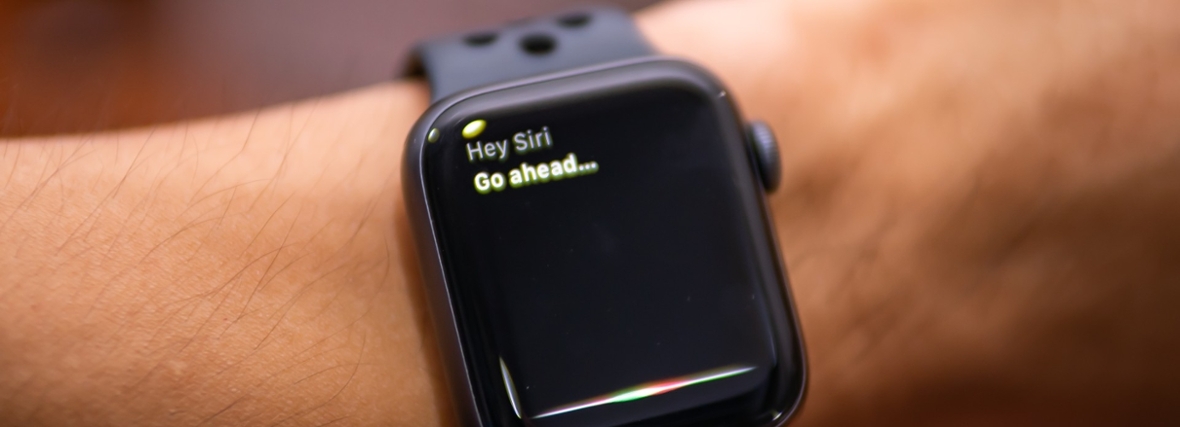
A good chat with Siri
Ask Siri, Apple’s virtual assistant, anything and you’ll get a more than detailed answer. But it won't be a real conversation, like between two people. Stephan Raaijmakers, Professor by Special Appointment of Communicative AI, is researching what is needed for humans and machines communicate naturally with each other. Inaugural lecture on 18 December.
Language is central to the work of Stephan Raaijmakers, now an AI researcher but once upon a time a literature student at Leiden University. This Professor by Special Appointment of Communicative AI takes a mathematical look at natural language processing. He is working on a challenge that AI has faced for decades: how do we get a machine to communicate like a human?
Voice activated assistants
It almost feels as though we can already talk to computers: take voice activated assistants like Siri or Alexa. You can ask them anything, from the latest news and weather to the distance from here to the nearest planet. ‘But you can’t ask them to talk about what you said an hour ago,’ says Raaijmakers. ‘You can ask Google Home to turn the light on at home and even to set them to “cosy”, but that’s about the limit.’
Memory, attention and ability to adapt
This is communiation, but it is not natural communication, like between two people. ‘Three aspects are essential here: memory, attention and ability to adapt,’ says Raaijmakers. ‘In conversations we use what we call the conversational memory. This contains information about the topic that we’re discussing, combined with general background information or knowledge about the world. It also contains information from previous conversations with this person, the context of the conversation and information about the person themselves. We use attention to determine which parts of the conversation are most important and whether the person we are talking to has understood us. But we also use it very specifically to retrieve relevant information from our conversational memory for that conversation. On the basis of signals from the person we are talking to we adapt our conversation, for instance by giving a better explanation of something or conversely by leaving it out.’
A good natter with Siri
Many new AI techniques have emerged over the past few years, deep learning in particular, which have advanced these three aspects in particular. ‘We can create and use reasonably complex memories, we can replicate and direct certain foms of attention with AI models, and systems are becoming increasingly adaptive.’ Raaijmakers is therefore hopeful that communicative AI will now take off. ‘Although I would add that we are by no means there yet. We won’t be having a good natter with Siri in five years’ time.’
Science in practice
As a professor by special appointment, Raaijmakers divides his time between Leiden University and TNO, where he also holds a post. A valuable combination. ‘I can put scientific knowledge into direct practice and test it. And the contact with partners from society means that you know which topics are at play, and you can focus your scientific research on them. Both parties benefit from this interaction.’
Reduce police workload
One example of this is a research project that Raaijmakers is working on at TNO with the Rotterdam police force. He wants to develop a conversational officer – a kind of chatbot – that can help police officers gain information about an incident. ‘Imagine the police are sent to an incident where a confused person is said to be causing trouble. The idea is that when they get there they can ask this system questions, for instance about family relationships or support services. The system doesn’t only provide that information but also thinks about what else the officers might need to know: “do you need information about their employment history or previous incidents?” The officer can also add information to the system, for instance that he has found a weapon on the person in question.’ At present police officers have to call a colleague at the police station, but don’t have much time for this. ‘A system like that can therefore reduce people’s workload in the end. But we than have to teach it to communicate naturally, almost like that colleague at the police station.’