
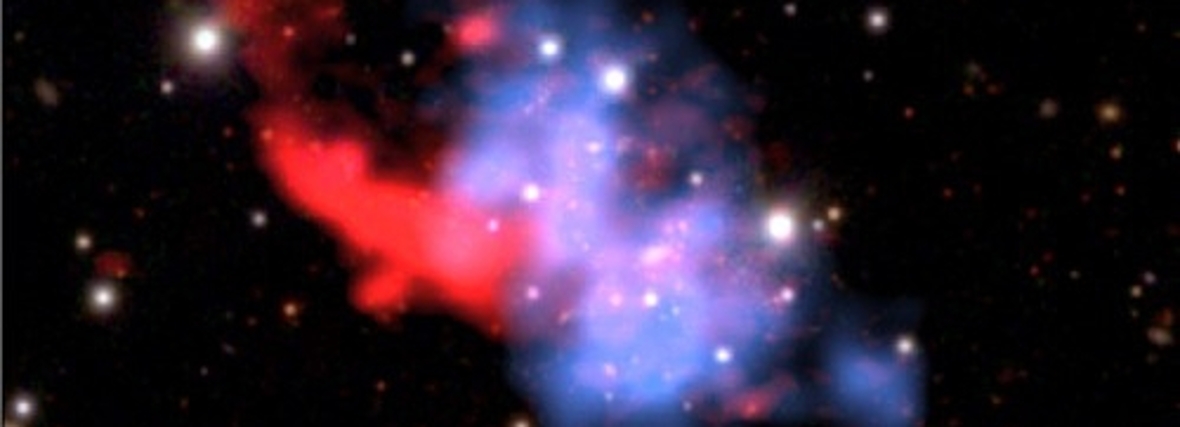
Astronomers see gigantic collisions of galaxy clusters in young Universe
An international team of researchers led by Leiden Observatory has mapped nine gigantic collisions of galaxy clusters. The collisions took place seven billion years ago and could be observed because they accelerate particles to high speeds. It is the first time that collisions of such distant clusters have been studied. The researchers publish their findings in the journal Nature Astronomy on DATE!!!
Speed of light
Galaxy clusters are the largest structures in the Universe. They can consist of thousands of galaxies, each with billions of stars. When such clusters merge, the electrons between them are accelerated to almost the speed of light. The accelerated particles emit radio waves when they come into contact with magnetic fields in the clusters.
Radio telescope
Until now, telescopes were not powerful enough to receive radio waves from distant colliding clusters. But thanks to the Dutch-European network of linked LOFAR antennas and an 'exposure time' of eight hours per cluster, the researchers were able to collect detailed data from distant clusters for the first time.
Acceleration
The data shows, among other things, that the radio emission from distant colliding clusters is brighter than previously expected. According to prevailing theories, cluster radio emission originates from electrons that are accelerated by the turbulent motions. Research leader Gabriella Di Gennaro, PhD candidate at Leiden Observatory, adds: ‘We therefore think that the turbulence and vortices caused by the collisions are strong enough to accelerate particles also in a young Universe.’
Unexpected
Furthermore, the magnetic fields in the distant clusters turned out to be about as strong as in previously investigated nearby clusters. According to co-author and magnetic field expert Gianfranco Brunetti (INAF-Bologna, Italy), this was unexpected: ‘We do not yet know how these magnetic fields can be so strong in a still young universe. We hope that future observations of distant clusters will provide more insight.’
Publication
- Gabriella Di Gennaro et al. Fast magnetic field amplification in distant galaxy clusters, Nature Astronomy (2020)
----------------------------------------
Image: A distant cluster of galaxies (PSZ2 G091.83+26.11) at 7 billion light years from Earth.
(c) PanSTARRS/NASA/ Chandra/LOFAR
Source: astronomie.nl