
Special Earthly life on display in Old Observatory photo exhibition
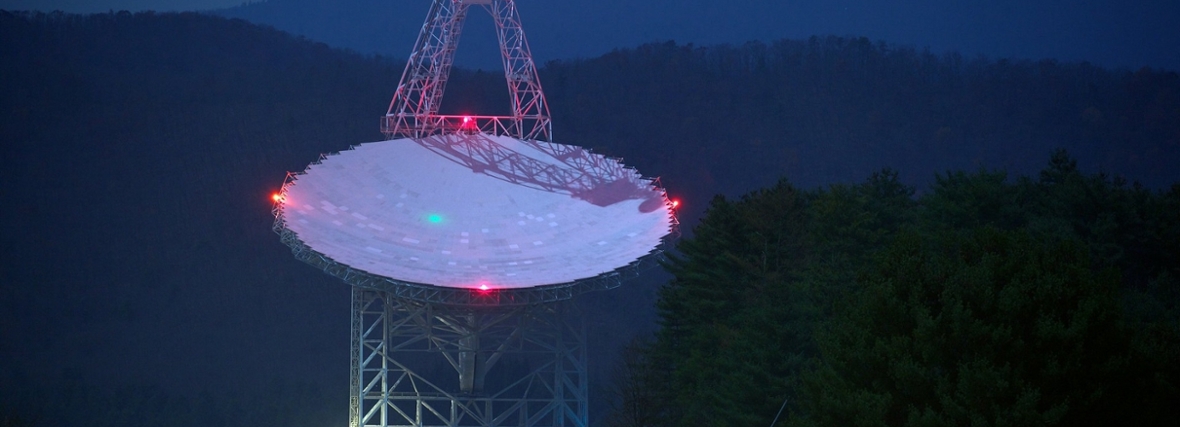
Two radio telescopes in Green Bank, West Virginiahave brought together a few remarkable people. A new photo exhibition in the Old Observatory visitor centre gives an insight into the remote community.
Radio silence
It covers an area almost the size of the Netherlands: the radio quiet zone in Pocahontas county, West Virginia. Using mobile phones or Wi-Fi is not allowed, because in the middle of the quiet zone stand the Green Bank Observatory, five giant radio telescopes. Every bit of electromagnetic radiation can influence sensitive measurements and undo precious scientific work.
The absence of interfering radiation has led to generations of astronomers coming to the remote town in the Appalachians. But the ban on Wi-Fi has also attracted a group of people with electromagnetic hypersensitivity, people who claim that mobile phones and other devices cause illness. In a town of only 143, that results in a curious mixture of astronomers, sceptics and the locals who have been living in the hills self-sufficiently for generations.
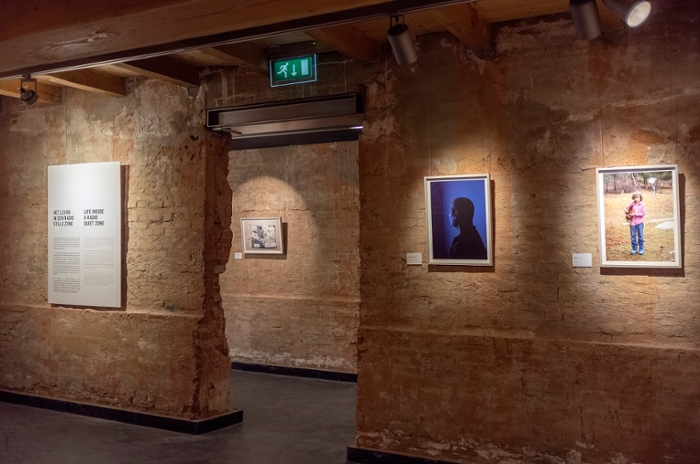
It was this rare confluence of people that led photographers Paul Kranzler and Andrew Phelps to West Virginia to document the life in Green Bank. In the cellar of the Old Observatory the most beautiful pictures from their project The Drake Equation are on display. Images of awe-inspiring machinery alternate with portraits of bear hunters, guns at the ready. Just like in Green Bank itself, the exhibition brings together a varied cast of characters to an unexpected whole.
Extra-terrestrial life
The exhibition is named after the famous equation by American astronomer Frank Drake. His eponymous equation, which he drew up while working and living in Green Bank, is a mathematical formula that can be used to estimate the number of intelligent life forms in the universe. Enter the number of stars that are formed, the number of stars that have Earth-like planets, and the chance that life arises on such a planet and you should get a rough estimate of the number of extra-terrestrial lifeforms.
The exact numbers you fill in strongly influence the end result of the equation. A conservative estimate leads to the conclusion that Earth is the only planet with intelligent life. But according to others the number of alien civilisations might be as high as 15 million. Most visitors haven’t made up their mind yet. A board invites them to leave their thoughts on the matter. Some seem to find alien life rather scary, while another has enthusiastically drawn a Star Trek starship. The question whether people would want to live in a radio quiet zones seems easier to answer: people cannot live without Wi-Fi.
No difference
The Drake Equation exhibit proves you don’t have to go into outer space to find interesting life forms. On one of the pictures, a radio telescopes rises above a boggy wood. An older man looks intently at a computer screen, but is he a scientist looking for alien life, or is he a Wi-Fi evader with a tinfoil hat only just out of frame? In Green Bank, the residents don’t register the difference. In this exhibition photographers Kranzler and Phelps have erased the boundaries and created an almost alien harmony.
The exhibition ‘The Drake Equation’ is open to the public every Saturday and Sunday, in the visitors’ centre of the Old Observatory in the Hortus Botanicus Leiden. The exhibition will run until 31 May. The photographs have also been published as a book. Wired, National Geographic and the New York Times have written about the project.