

Exhibition shows Leiden scientists' love of collecting
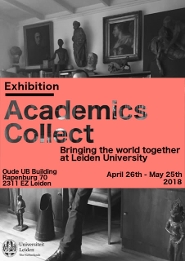
From Maria Yazdanbakhsh's Kenyan fertility dolls to the first Hortus plants brought back by Carolus Clusius. Students of the Master's in Museums and Collections have put together an exhibition made up of collections owned by Leiden scientists. ‘Academics Collect’ can be seen from 26 April to 25 May at Rapenburg 70, in the Oude UB.
Magical Egyptian dishes, Neanderthal axes, antique timekeeping calendars, fertility dolls, an imposing sculpture made of lime wood, and much more. The diversity of these collections is immediately noticeable. This is the fifth exhibition organised by art historian and lecturer in museum studies Nana Leigh with her students, in the Old University Library. ‘This time I wanted to show just how rich and diverse the collections are that our researchers are amassing.'
Tijdrekenkalenders
Justus Scaliger (1540-1609) was one of the first great scholars at Leiden University. After his death he left all his rare manuscripts and books in Oriental languages to the University Library. Since Scaliger, many other academics have donated their collections to the university. One of these collections comprises the Gregorian and Julian chronological calendars of Professor of Chronology W.E. van Wijk (1887-1955), which can be seen at the exhibition. Van Wijk tried to link the diverse calendars from world history to one another in order to gain a better understanding of when events took place.
Necklace of monkey bones
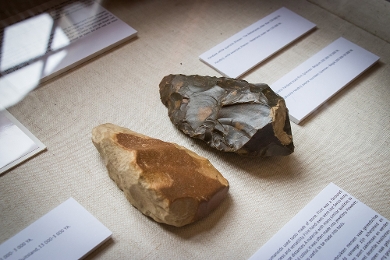
Seven collections are from the Special Collections of the University Library, eight from contemporary collectors that are often related to their own research. Professor of Parasitolooty Maria Yazdanbakhsh is exhibiting her Sri Lankan dolls with damaged limbs, fertility dolls from Kenya and a necklace of monkey bones from Tanzania. There are Neanderthal flint axes found by archaeologist Jan Kolen himself and a splendid mammoth tooth. Arab specialist Remke Kruk is exhibiting magical dishes from Egypt that are used for rituals, and photos of wall paintings that portray the pilgrimage to Mecca.
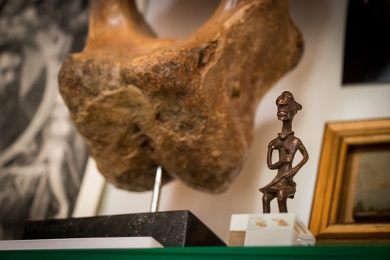
Mammoth vertebra
The biggest exhibit is the man-height, lime-wood statue ‘Entre deux’ by Stanslias Lélio from the collection of Louk Tilanus, an expert on sculptures. This art historian's broad interests can be seen clearly. The glass cabinet displaying his collection is full of splendid African images, 19th-century sea views, prints, shells and even the vertebra of a mammoth. He commented, 'I am proud that I am able to show a few items from my collection among these illustrious collectors.'
Leerzaam college
Putting together an exhibition is an excellent learning experience, master's student Carin Kraal-van der Leeuw explained enthusiastically. In the lectures a lot of attention was paid to the theory behind museum exhibitions, and this exhibition in a big practical task. The eighteen students were divided into groups, each of which was responsible for part of the exhibition, such as arranging the loan of the items, the texts for the exhibition, the design and organising the publicity. Kraal-van der Leeuw commented: ‘We are now learning how to put together an exhibition. Each collection is interesting, but we also have to ensure a good coherence and variety of objects and that the exhibition is interesting and clear for visitors. It's only when you are putting together an exhibition yourself that you realise the kind of challenges museums face.'
(LvP)