

Noise at work
When working in a loud noise environment, day in day out it can lead to a hearing impairment.
When working in a loud noise environment, day in day out it may lead to hearing impairment. A previous safety issue concerned risks caused by wearing headphones for listening to music. More frequently it is necessary to wear something in the ear (or to cover them) to protect ourselves from hearing damage by high noise levels.
However, a hearing impairment is not the only risk; it can also lead to increased blood pressure, ringing in the ear, elevated stress levels, fatigue, and loss of concentration. The operation of large analyzers, fume hoods, biosafety cabinets, incubators, cell washers, tissue homogenizers, and stirrer motors, all contribute to the noise level. Other sources of noise in laboratories include fans and compressors for cryostats, refrigerators, refrigerated centrifuges, and freezers. As an example, a high speed refrigerated centrifuge alone can generate noise levels as high as 65 dB.
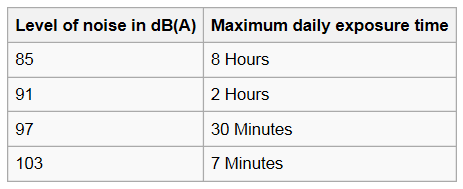 There are several regulations regarding noise at the workplace: when employees are exposed to noise higher than 80 dB, the employer is required to provide hearing protection. At noise exposure higher than 85 dB, the employee is obliged to wear the hearing protection.
In addition there are several precautions to minimize noise in the laboratory;
- Moving noise-producing equipment from the laboratory to an equipment room;
- Providing acoustical treatment on ceilings and walls.
The key is to identify lab equipment that is producing excess noise in the work area and implement controls to keep noise levels below the limits. However, in certain workplace conditions, there is very little or nothing one can do to reduce noise at the source. In such workplaces, employees wear hearing protectors to reduce the amount of noise reaching the ears. There are different types of hearing protectors available;
- Ear plugs are inserted to block the ear canal. They may be pre-molded (preformed) or moldable (foam ear plugs). Ear plugs are sold as disposable products or reusable plugs. Custom molded ear plugs are also available.
- Semi-insert ear plugs which consist of two ear plugs held over the ends of the ear canal by a rigid headband.
- Ear muffs consist of sound-attenuating material and soft ear cushions that fit around the ear and hard outer cups. They are held together by a head band.
 If noise levels exceed 80 dB, people must speak very loudly to be heard, while at noise levels of 85 dB, people have to shout to communicate with coworkers who are an arm’s length away.
If the noise level in the laboratory is too high for the staff to hear what is being said, whether in conversation or on the telephone, there is a danger of misunderstanding instructions or laboratory results.
A follow-up danger is that by misunderstanding also accidents can happen by e.g. misuse of equipment.