
Wiser with wisebits
‘Is it possible to get used to absolutely anything?’ ‘In science you can't lie.’ On 16 October, as part of the Key of Life festival, two series of wisebits will be shown at the Central Station. The project is a co-production by the RVU (an educational media company) and Leiden University.
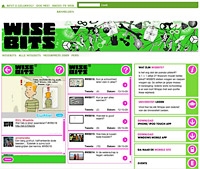
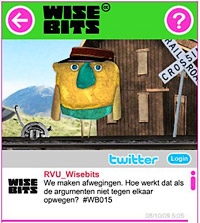
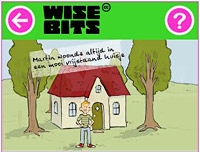
Friday 2 October saw the official start of the Wisebits 2.0 project of Leiden University and the RVU. Wisebits are film clips lasting a maximum of 90 seconds and explaining a particular scientific subject. Some clips are cartoons; others might show a researcher talking about his or her research, or they could feature a discussion between two scientists. Wisebits are aimed at young people, and school pupils in particular. Ideally they would watch a new wisebit every day; the idea is to make two hundred of these film clips.
Well-known
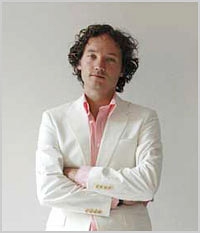
The initiators of this project are a group of scientists who work closely with Professor of the Public Concept of Science, Bas Haring. These scientists include Ionica Smeets, one of the Maths girls, and Olga Crapels, affiliated to the Arts & Genomics Centre and PhD researcher at the Institute for Religious Studies. The RVU plays a key role: the company makes the films and puts them on the website. Professor Haring and the RVU are well known to one another: Haring has already made a number of programmes with the broadcasting company, including Haring and Stof.
Wisebits 2.0 has been awarded a subsidy of 350,000 euro as part of the Social Sectors & ICT action programme.
Not just odd facts
The films that can be seen on RVU Wisebits by no means follow a set formula. So far, no strictly physics or chemistry-related laws have been expounded. 'That's right,' says Haring. 'We don't want to show the end-product of science nor the process, so there are no experiments. Nor are we interested in just quoting odd facts. We look at science in a more general sense, and focus on the conditions surrounding science. For example, that scientific findings have to be verifiable.’
Fresh ideas

How are the subjects decided on? Haring: ‘Our group has regular meetings to think of new subjects. We base our ideas on particular themes or research that we have read about. We invite people from outside the group, generally friends who work in the scientific world, to the meetings to keep the flow of ideas fresh and to balance the fields of science covered. We write a text of about 300 words on each subject and send the text to the RVU; they then have a film made based on the text.'
The RVU has also organised the RVU Media Prize ‘09 for the three best wisebits made by youngsters themselves.
Schools
The intention is to make the wisebits as broadly accessible as possible; everyone can use them, the RVU has no exclusivity rights, although the company is prominently visible. The initiators also hope that schools will make use of the films. To encourage schools to get involved, the ICLON is devising assignments to accompany the wisebits, that will be freely available on Wisebits Academy. The first lesson assignments are already available on the website.
Pandering to the young
But doesn't the concept of wisebits go too far in trying to appeal to young people, in other words producing films that are short, fun and fast? Won't young people who make it to university get the shock of their lives when they realise that their wisebits days are over and they are expected to read thousands of pages of what is often very dry text. Are you not pandering too much to young people with these wisebits? Haring absolutely rejects this suggestion. 'Part of the challenge is in making things simpler and more succinct, getting back to the essence of the issue. It's trie, of course, that the subjects are not put in any context. When you study at university, you do have to study the context. I have nothing at all against students having to read lots of the relevant literature.'
October: Knowledge Month
- On Friday 16 October, a series of wisebits can be seen on the square in front of the Central Station, as part of the Key of life festival in which art meets science.
- The annual Science Day takes place on Sunday 18 October. The Faculty of Science and most Leiden museums will be participating, and many of the activities are aimed at children.
Studies that match the subject of this article
- The Bachelor's in Computer Science gives direct admission to the Master's in Media Technology.
- Part of your bachelor's programme can include the Practical Study in Journalism and New Media,
- This leads directly on to the Master's in Journalism and New Media.