
New Threat Monitor: fewer contract killings, more focus on intimate partner violence
image: Arash Nikkhah
Threats against mayors, foreign interference and intimate partner violence: providing protection involves a wide range of security issues. The new Threat Monitor maps out developments and challenges.
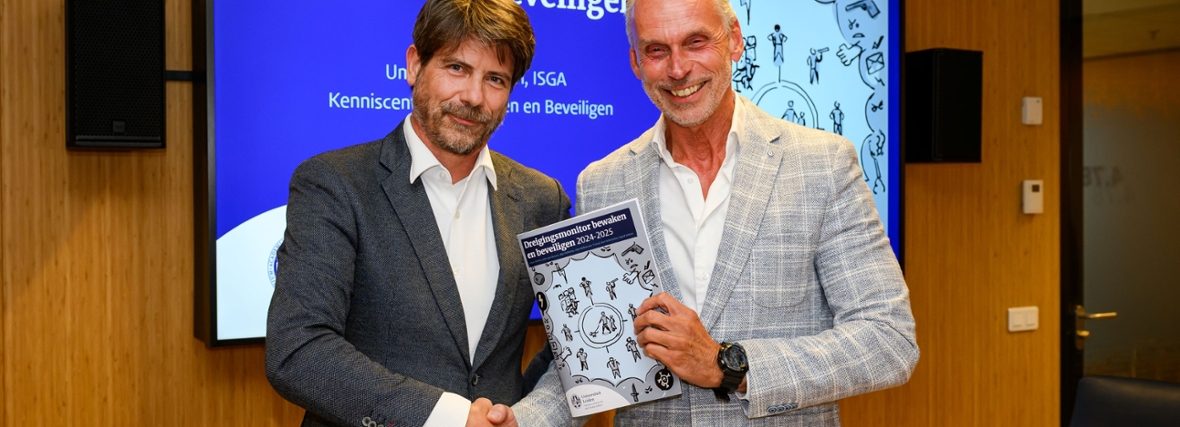
The first copy was presented in late September in the Wijnhaven boardroom to Ruud van Ginkel, chair of the Knowledge Centre Surveillance and Protection. Professionals from the Public Prosecution Service, the Royal Netherlands Marechaussee and the police attended alongside the authors. The Leiden University researchers presented their chapters and discussed what their findings mean for professional practice.
The monitor examines how threats developed in 2024 and 2025. According to Edwin Bakker, Professor of Terrorism and Counterterrorism, the different types of threat are described separately, but are difficult to disentangle in practice. This edition also pays particular attention to threats surrounding accommodation for asylum seekers, given their impact on politics and society.
State-based threats
Terrorism researcher Bart Schuurman co-authored the chapter on threats from state actors with Jelle van Buuren. ‘International conflicts have repercussions in the Netherlands. We saw this with 9/11, and we are seeing it again now,’ said Schuurman. He pointed to Russia’s war against Ukraine and the conflict between Iran, Israel and the United States, whose effects have been felt here.
He also highlighted vulnerability to drones and the use of so-called ‘disposable agents’: often young people recruited via Snapchat or Telegram to carry out tasks. This approach bears similarities to recruitment by criminals. Systematically collected data are needed to establish how the threat is developing. ‘What we need here is the best possible data.’

Putting threats into perspective
Van Buuren emphasised the importance of reliable data collected over a longer period. Research into sovereign citizens, for example, shows that only a small number are willing to use violence and pose a danger. Presenting the entire movement as a major security threat does not, in his view, reflect these findings. Data also help put incidents involving conspiracy theorists into perspective. He referred to research linking fewer than two hundred criminal offences between 2019 and 2022 to people who believe in conspiracy theories. These often involved insults and incitement. ‘There have been a few high-profile incidents, but you should not overstate the danger. Yet that is something you often see happening.’
Organised crime
Researcher Stijn van ’t Land examined developments in organised crime and found a downward trend in the number of gangland killings in recent years. ‘Figures on organised crime also need to be interpreted carefully. Attacks involving explosives remain a major problem, while the conditions that can give rise to serious violent conflicts are still present. The cocaine trade is still there, as are conflicts within the drug trade. If a conflict like that flares up, it can lead to renewed serious violence. Look at the recent incident in Overasselt.’
Intimate partner violence
Roy Hofkamp discussed intimate partner violence, an issue the researchers had already called for greater attention to in the first Threat Monitor. ‘This is the deadliest phenomenon, claiming dozens of lives each year, mostly women. Political and societal initiatives have since emerged, but the question is whether they actually reduce the number of victims. How can we bring those figures down further? I believe we can, if professionals, neighbours and family members pay attention to warning signs.’
Public officials under pressure
Researcher Ingrid Zeilstra worked with Jelle van Buuren and Stijn van ’t Land to investigate threats against local politicians and officials over plans for asylum seeker centres. ‘After peaking around 2015 and then declining, these threats began to increase again from around 2024. Mayors were targeted in roughly three-quarters of the cases examined. The threats were often verbal, but some involved a physical element, such as a GPS tracker placed under a mayor’s car.’
It is difficult, however, to establish how much such threats influence decisions about accommodating asylum seekers. Van Buuren emphasised that threats against local politicians and officials rarely lead to physical violence, but can seriously undermine democracy and the rule of law. ‘Things are unlikely to settle down any time soon.’
Researcher Marieke Zomerdijk noted that studies of threats against politicians use differing definitions. Some surveys include anything respondents themselves perceive as threatening. ‘Are we actually talking about the same concept?’ Her research focuses on defining the concept more clearly and examining trends in threats and incidents.
From research to practice
Edwin Bakker emphasises the difference between day-to-day security work and the pace of politics and the media. ‘Incidents attract attention, moving from one talk show to the next, and then it is all over.’ Meanwhile, professionals continue to address less visible threats. The researchers therefore continue to monitor both longstanding and emerging threats. ‘Not everything is always getting worse, but one thing we know for certain: everything is always changing.’
On receiving the monitor, Ruud van Ginkel emphasised the value of collaboration between research and practice. The knowledge centre aims to share the monitor’s findings with professionals and officials who make decisions about security and the allocation of resources.
He also called for attention to resilience and risk acceptance. ‘How can officials deal with threats? What does risk acceptance mean, and how can we make it tangible?’ Van Ginkel sees opportunities for further research that could help officials and security professionals make decisions in their daily work.
